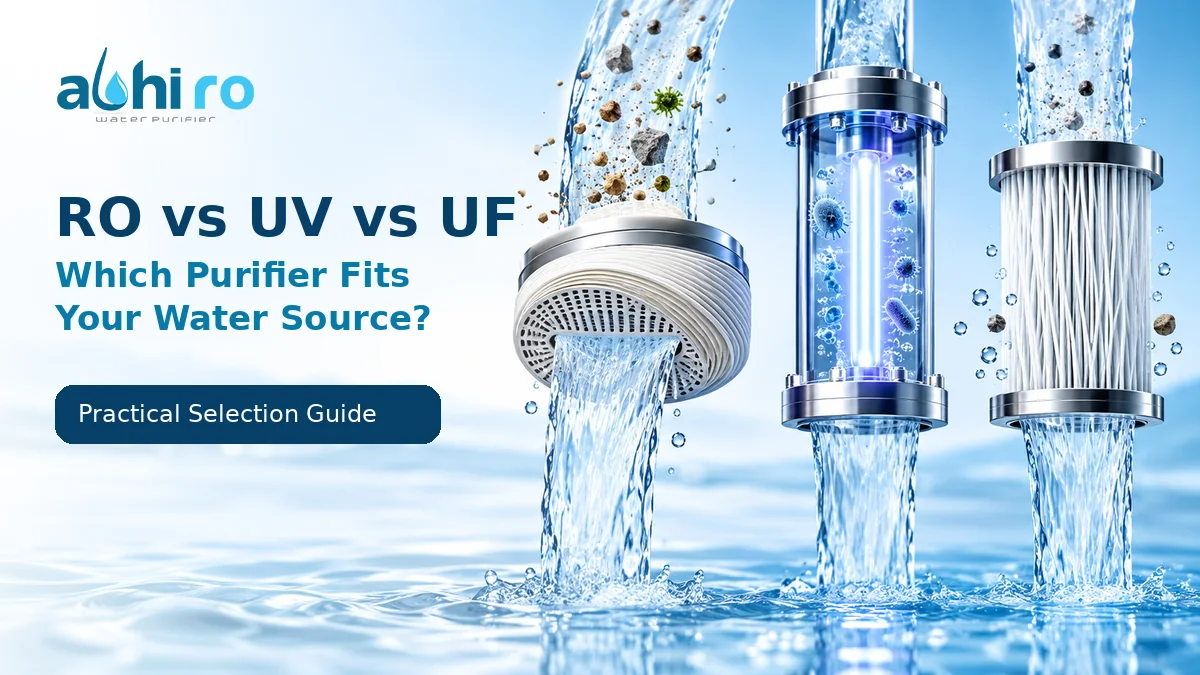
The right choice between RO, UV and UF depends on your source water—not on the number of purification stages advertised. RO is mainly used when dissolved salts are excessive; UV addresses microorganisms in clear water; UF physically filters suspended particles and many microorganisms without electricity. Test the water first, then select the treatment combination that addresses the actual risk.
What You Will Learn
- A quick RO, UV and UF comparison
- When RO is appropriate
- When UV is appropriate
- When UF is appropriate
- How to select the right system
- Maintenance factors
- Frequently asked questions
RO vs UV vs UF: Quick Comparison
RO, UV and UF solve different water-quality problems, so one technology is not automatically better than the others. A useful comparison starts with what each process can and cannot remove.
| Technology | Main role | Works on dissolved salts? | Typical operating need |
|---|---|---|---|
| RO | Reduces dissolved salts and selected dissolved contaminants | Yes | Pressure, electricity and reject-water arrangement |
| UV | Inactivates susceptible microorganisms | No | Electricity and clear water |
| UF | Physically filters fine suspended matter and many microorganisms | No | Suitable pressure; some units can work without electricity |
Many domestic purifiers combine technologies because a home may need more than one treatment barrier. However, adding stages that do not address a measured problem increases maintenance without necessarily improving the result.
When an RO Water Purifier Is Appropriate
RO is most relevant when a water test shows that dissolved salts or specific dissolved contaminants need reduction. This is common with some borewell and tanker-water supplies around Coimbatore, but source quality can vary greatly even between nearby properties.
- RO pushes water through a semi-permeable membrane under pressure.
- It produces purified water and a concentrate stream that must be drained or reused appropriately.
- Pre-filters protect the membrane from sediment and chlorine, depending on system design.
- Feed-water pressure, temperature and chemistry affect output and recovery.
Do not choose RO only because the raw-water TDS number looks high or low on a handheld meter. TDS is a useful screening measurement, but it does not identify individual salts, microorganisms or toxic contaminants. A proper water analysis and intended use should guide the decision. See ABHIRO’s domestic RO membrane range when planning replacement or system service.
When a UV Water Purifier Is Appropriate
UV treatment is appropriate when microbial control is needed and the incoming water is sufficiently clear for ultraviolet light to reach microorganisms. It does not remove dissolved salts, hardness, sediment or chemical contamination.
A UV chamber should receive properly pre-filtered water. Turbidity, colour, scale on the quartz sleeve, an aged lamp or inadequate flow control can reduce effective exposure. UV also does not provide residual disinfection after water leaves the chamber, so hygienic storage and plumbing remain important.
When a UF Water Purifier Is Appropriate
UF is useful when the objective is physical removal of fine suspended particles and many microorganisms while retaining dissolved minerals. It can suit relatively low-TDS water where dissolved-salt reduction is unnecessary.
UF membranes have fine pores but do not reduce dissolved salts or hardness. Their performance depends on pore rating, membrane integrity, feed-water condition and cleaning or backwashing arrangements. Heavy turbidity may require sediment pretreatment. ABHIRO’s 20-inch jumbo UF membrane page illustrates one available pre-filtration format; confirm suitability against actual flow and water quality before selection.
How to Select the Right Purifier in Five Steps
The safest selection method begins with the source and test results, then matches each identified issue to a treatment barrier. Follow these steps before comparing models.
- Identify the source. Note whether water comes from the corporation supply, borewell, tanker, rainwater system or a mixture. Mixed sources should be assessed under the least favourable expected condition.
- Test representative water. Check basic parameters such as TDS or conductivity, pH, turbidity and hardness, plus microbiological or chemical parameters relevant to the source and local risk.
- Match technology to the problem. Use RO for required dissolved-solids reduction, UV for microbial inactivation in clear water, and UF for a physical membrane barrier where dissolved-salt removal is not required.
- Check installation conditions. Confirm feed pressure, electricity, drain access, storage capacity, available space and likely daily demand.
- Plan maintenance before purchase. Ask about genuine consumables, service access, filter-change indicators, sanitisation and the expected frequency of water-quality checks.
If you are unsure what to test, review ABHIRO’s water testing kits and meters. The broader ABHIRO product range can also help you compare domestic purifier systems, membranes, pumps, housings and replacement filters.
Maintenance Differences That Affect Ownership
Every purifier needs scheduled maintenance, but the service items differ. Choosing a system without considering consumables and local support can lead to declining water quality or unnecessary expense.
- RO: sediment and carbon pre-filters, membrane performance checks, sanitisation, pressure verification and reject-flow inspection.
- UV: lamp replacement according to the equipment guidance, quartz-sleeve cleaning, electrical checks and flow verification.
- UF: flushing or backwashing, integrity observation, sediment pre-filter service and membrane cleaning or replacement when required.
Regardless of technology, test treated water periodically and after prolonged shutdown, major plumbing work or a noticeable change in taste, odour, colour or output. A purifier should complement safe storage and good household hygiene, not substitute for them. For wider buyer context, read why homes may need a suitable water purifier.
Frequently Asked Questions
Is RO necessary for every home?
No. RO is appropriate when the water analysis and intended use indicate that dissolved salts or particular dissolved contaminants need reduction. For suitable low-TDS water, another treatment combination may be more appropriate.
Does UV reduce TDS or hardness?
No. UV treatment targets susceptible microorganisms; it does not remove dissolved salts, hardness or sediment.
Can UF replace RO for borewell water?
Not when dissolved-salt reduction is required. UF removes fine suspended matter and many microorganisms but allows dissolved salts to pass. Test the borewell water before deciding.
Can one purifier combine RO, UV and UF?
Yes, combination systems are available. The useful question is whether each stage addresses the source-water risks and whether the complete system can be maintained correctly.
Get a Water-Source-Based Recommendation from ABHIRO
Share your water source, recent test results, daily requirement and installation location with ABHIRO Water Purifier in Coimbatore. Our team can help you compare suitable RO, UV, UF and combination options without adding unnecessary treatment stages. Call +91 99430 99998 or contact ABHIRO for practical product-selection and service guidance.