Water tank turnover compares stored volume with the quantity used over time. Estimate nominal residence time by dividing the operating water volume by average daily withdrawal, then review peak demand, backup needs and actual mixing. The result is a planning indicator, not a water-safety guarantee or a universal instruction to empty the tank daily.
What You Will Learn
- Understand turnover and residence time
- Calculate a first estimate
- Separate tank size from operating volume
- Balance backup and regular use
- Inspect the storage arrangement
- Frequently asked questions
Turnover Is About Water Use, Not Tank Material Alone
A storage tank that is much larger than regular demand may hold water longer than expected. Stainless steel, FRP or another suitable material does not remove the need for sound storage operation, cleaning and protection from contamination.
Turnover is often expressed as the volume used relative to stored volume over a period. Nominal residence time expresses the inverse relationship: how long the operating volume would take to pass through at the average withdrawal rate. Neither calculation describes the exact age of every litre because filling, draining and mixing happen together.
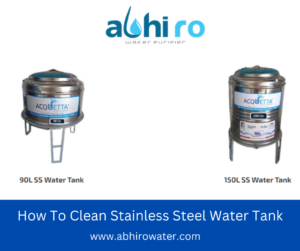
This guide concerns atmospheric water-storage tanks for homes, institutions and commercial facilities. It is not a pressure-tank drawdown calculation or a chemical-storage design method. Browse ABHIRO’s SS water-tank category for storage options, then assess capacity against the actual duty.
Calculate Nominal Residence Time From Operating Volume
Use measured daily withdrawal and representative operating volume rather than the largest number printed on a brochure.
Nominal residence time in days = Operating water volume in litres ÷ Average withdrawal in litres per day.
If a tank typically holds 2,000 litres and the facility withdraws 1,000 litres per day, the simple estimate is two days. If demand falls to 250 litres per day during a closure, the same calculation gives eight days. These are arithmetic examples, not acceptable storage-time limits.
- Measure or reasonably estimate daily withdrawal over a representative period.
- Record typical high and low water levels, including changes during weekends.
- Estimate the water volume actually present during normal operation.
- Divide that volume by average daily withdrawal using consistent units.
- Repeat for low-demand conditions rather than relying on the busiest day.
- Review the result alongside water quality, treatment, temperature and the intended use.
A single monthly water bill may include gardening, cleaning or another supply that never passes through this tank. Use a meter on the relevant line where practical, and distinguish tank inflow from withdrawal if levels are changing significantly.
Gross Capacity, Usable Volume and Reserve Are Different
A tank’s total geometric capacity is not always its usable supply volume. The outlet position, low-level pump cutoff, high-level fill setting and freeboard determine how much can be withdrawn safely.
- Gross capacity: the vessel’s stated total storage capacity on its specified basis.
- Operating volume: the quantity present at the level being considered.
- Usable draw: the volume between normal high level and the minimum permitted operating level.
- Reserve: water deliberately retained for an approved backup requirement.
Do not lower the cutoff simply to improve a turnover calculation. That can compromise pump suction, allow air entry or reduce required reserve. Changes to operating levels should be reviewed against the tank, pumps and controls as a complete system.
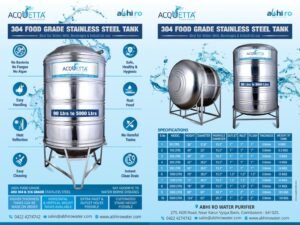
For horizontal tanks, level and volume are not linearly related across the full depth. Use the manufacturer’s capacity chart or suitable geometry rather than assuming half the height always represents half the usable draw between arbitrary settings.
Balance Supply Interruptions With Normal Consumption
The objective is enough usable storage for real demand and interruptions without unnecessarily enlarging the volume that must be managed. A larger tank may provide useful resilience, but its benefit should be explicit.
For a Coimbatore home or business using municipal, borewell or tanker supply, document the supply pattern rather than assuming all sources arrive daily. Commercial users should include operating shifts, cleaning demand and periods when production stops. Keep potable, process, reclaimed and fire-water requirements distinct; do not repurpose dedicated reserves without the responsible designer’s approval.
- Identify the longest interruption the storage is intended to cover.
- Separate average consumption from short peak withdrawal.
- Check refill rate and available filling hours.
- Review holiday, weekend and seasonal low-use periods.
- Consider whether independently manageable compartments or tanks suit the duty.
Two tanks are not automatically better. Isolation, balanced use, maintenance access and control logic determine whether both receive meaningful turnover or one becomes a neglected standby.
Check the Installation, Not Just the Formula
A nominal residence-time estimate cannot reveal stagnant corners, short-circuiting or contamination routes. Inspect the physical arrangement and follow an application-specific water-quality management plan.
- Keep covers secure and inspect designated vents and overflow protection.
- Prevent cross-connections between treated and untreated supplies.
- Check whether inlet and outlet placement supports the intended circulation.
- Provide safe sampling access and record source changes.
- Maintain drains and cleaning access without entering the tank casually.
- Investigate sediment, unusual odour or quality changes promptly.
Tank entry can create confined-space hazards and requires competent assessment and controlled procedures. Do not prescribe a disinfectant dose or cleaning method from capacity alone. For treatment context, use the water-purification FAQs and Water Treatment Knowledge Centre.
Frequently Asked Questions
Does a two-day estimate mean every litre is two days old?
No. It is a simplified average based on volume and flow. Mixing and inlet–outlet arrangement affect actual water age.
Is there one safe residence time for all tanks?
No. Source quality, treatment, temperature, maintenance and use matter. Follow the relevant water-quality plan and professional advice.
Can stainless steel prevent all storage contamination?
No. Material selection is only one part of protection. Covers, connections, operation, cleaning and monitoring remain necessary.
Plan Practical Water Storage With ABHIRO
Contact ABHIRO Water Purifier, Coimbatore with daily demand, supply schedule, required backup, level settings and site dimensions. Review horizontal tank options where layout requires them, and confirm model dimensions, supports, connections and suitability before ordering.