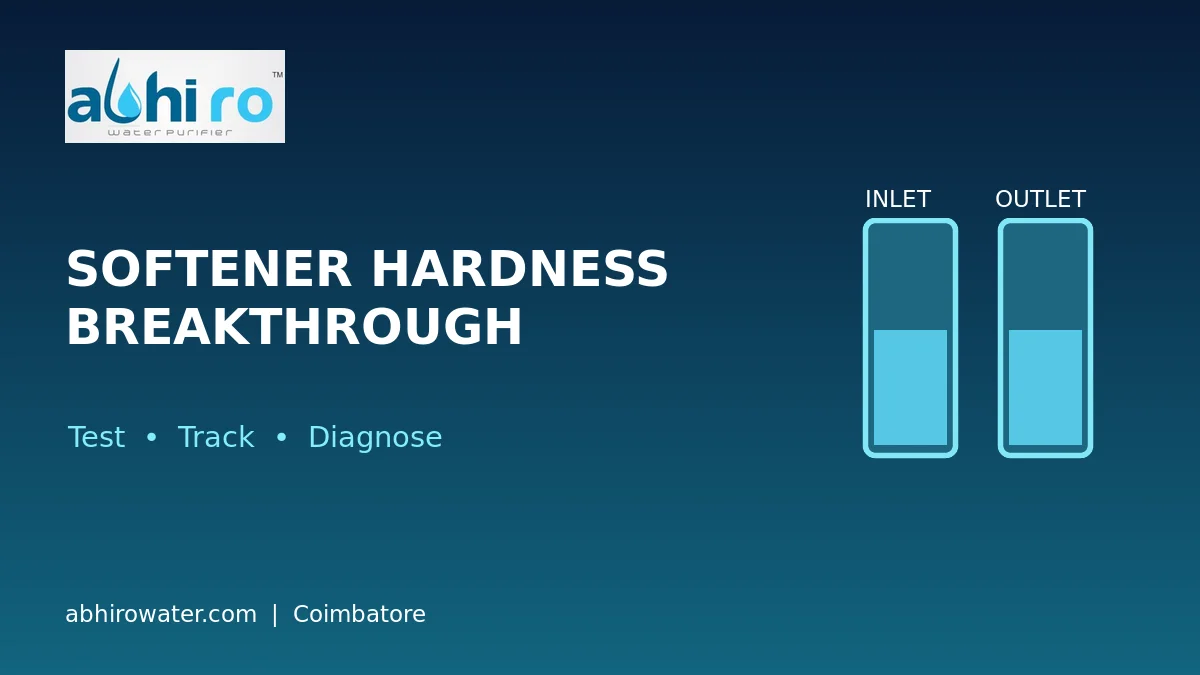
Softener hardness breakthrough means calcium and magnesium hardness is appearing in treated water beyond the required operating limit. Confirm the sample and test first, then compare leakage timing with flow, treated volume and regeneration history. Immediate leakage suggests different checks from gradual exhaustion, so do not replace resin or increase salt from one reading alone.
What You Will Learn
- Confirm the hardness result
- Use breakthrough timing to narrow the cause
- Follow a practical diagnostic sequence
- Check load and capacity
- Frequently asked questions
Confirm the Sample Before Changing the Softener
A valid outlet-hardness test must represent water leaving the softener, not mixed water from a downstream storage tank or a bypass connection. Label the inlet and outlet sampling points and record their locations.
- Flush stagnant water from the designated sample line following the site procedure.
- Use clean containers and a hardness test appropriate to the required measurement range.
- Check reagent expiry, sample volume, endpoint instructions and the kit’s stated units.
- Test inlet and outlet water during the same stable operating period.
- Repeat an unexpected result and arrange laboratory confirmation when the application requires it.
Report hardness as the method specifies, commonly mg/L as CaCO₃. Do not substitute a TDS reading: sodium-cycle ion exchange changes the ions present but does not act like RO desalination. ABHIRO’s water-testing checklist explains why individual parameters need separate monitoring.
Breakthrough Timing Helps Identify the Next Check
Hardness is present immediately after regeneration
First investigate incomplete regeneration, bypass or blending, internal valve leakage, incorrect cycle settings and abnormal distribution. Confirm that a complete cycle actually occurred, rather than relying only on a controller message.
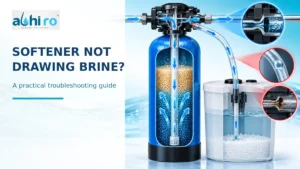
Check brine draw and rinse history. If the brine level did not fall as expected, use the separate brine-draw troubleshooting guide. This article focuses on the treated-water result; the brine guide covers suction-side faults in detail.
Hardness rises near the end of the service run
Compare treated volume and inlet hardness with the capacity used in the design. A change in source water or daily consumption can exhaust the available working capacity earlier even when the equipment is functioning.
A predictable rise after a similar hardness load suggests reviewing regeneration timing and reserve. It does not automatically establish that the resin is worn out. Meter accuracy and the controller’s hardness setting also need verification.
Hardness appears mainly during peak demand
Check actual service flow against the resin, valve and vessel design. High flow, poor distribution or a bypass path can reduce treatment performance before the calculated total capacity is exhausted. Record the flow when the abnormal sample is taken instead of testing only during quiet periods.
A Step-by-Step Hardness Breakthrough Investigation
Work from evidence and simple operating checks toward internal inspection. Opening a pressurised vessel or servicing electrical controls requires a competent technician and the approved isolation procedure.
- Document the symptom. Record inlet and outlet hardness, sample point, time, service flow and the required application limit.
- Check bypass and blending. Verify valve positions and whether untreated water can enter downstream through another connection.
- Review the last cycle. Confirm cycle completion, brine draw, rinse and refill using the installed valve’s instructions.
- Check salt availability. Look for bridging, inadequate preparation or an unsuitable salt condition without adding chemicals by guesswork.
- Verify controller inputs. Review time, hardness setting, meter function, regeneration trigger and reserve against the design.
- Compare service flow. Investigate peak loading and pressure changes, not only average daily consumption.
- Test after correction. Run a verified regeneration when justified and measure outlet hardness through the next service run.
- Escalate persistent faults. Arrange valve, distributor and resin assessment if operating checks do not restore performance.
Do not increase salt indefinitely to hide an unknown problem. Salt dose, brine concentration and contact time must follow the selected resin and system procedure. A damaged distributor or leaking bypass will not be repaired by adding more salt.
Compare Hardness Load With Working Capacity
Use hardness load rather than TDS or calendar days alone to judge the demand on a softener. Multiply treated volume by the inlet hardness reported on the same basis as the capacity calculation.
For illustration, 10,000 litres at 300 mg/L as CaCO₃ represents 3,000,000 mg, or 3 kg as CaCO₃, of hardness load. If inlet hardness rises to 450 mg/L at the same volume, the load becomes 4.5 kg. These values illustrate arithmetic, not a resin quantity or salt-dose recommendation.
Use the resin manufacturer’s working capacity at the intended regeneration conditions and include the design reserve. ABHIRO’s softener sizing calculation guide covers resin volume and hydraulic checks. Keep a log of volume between regenerations, salt used, inlet hardness and the point where outlet hardness begins to rise.
Frequently Asked Questions
Does hardness leakage mean the resin needs replacement?
No. Confirm sampling, bypass, service flow and regeneration first. Persistent capacity loss after those causes are corrected may justify resin testing or replacement.
What outlet hardness is acceptable?
Use the limit required by the downstream process, equipment supplier or treatment programme. A household application and an industrial utility may have different requirements.
Can a softener show normal TDS but poor softening?
Yes. TDS is not a direct hardness test. Measure hardness specifically to assess calcium and magnesium removal.
Get Softener Performance Support in Coimbatore
ABHIRO Water Purifier supplies softening systems and treatment components for domestic, commercial and industrial users. Browse the Water Softener category or contact ABHIRO with inlet and outlet results, resin volume, valve model, peak flow, regeneration settings and treated-volume history. These details help separate a setting problem from a component or capacity issue before replacements are ordered.