An industrial reverse-osmosis plant cannot be managed reliably by
checking product-water TDS alone. Feed-water chemistry changes,
pretreatment performance varies, and operating conditions can gradually
move away from the original design. Without consistent readings,
membrane scaling, fouling, chemical overdosing or declining salt
rejection may remain unnoticed until production is affected.
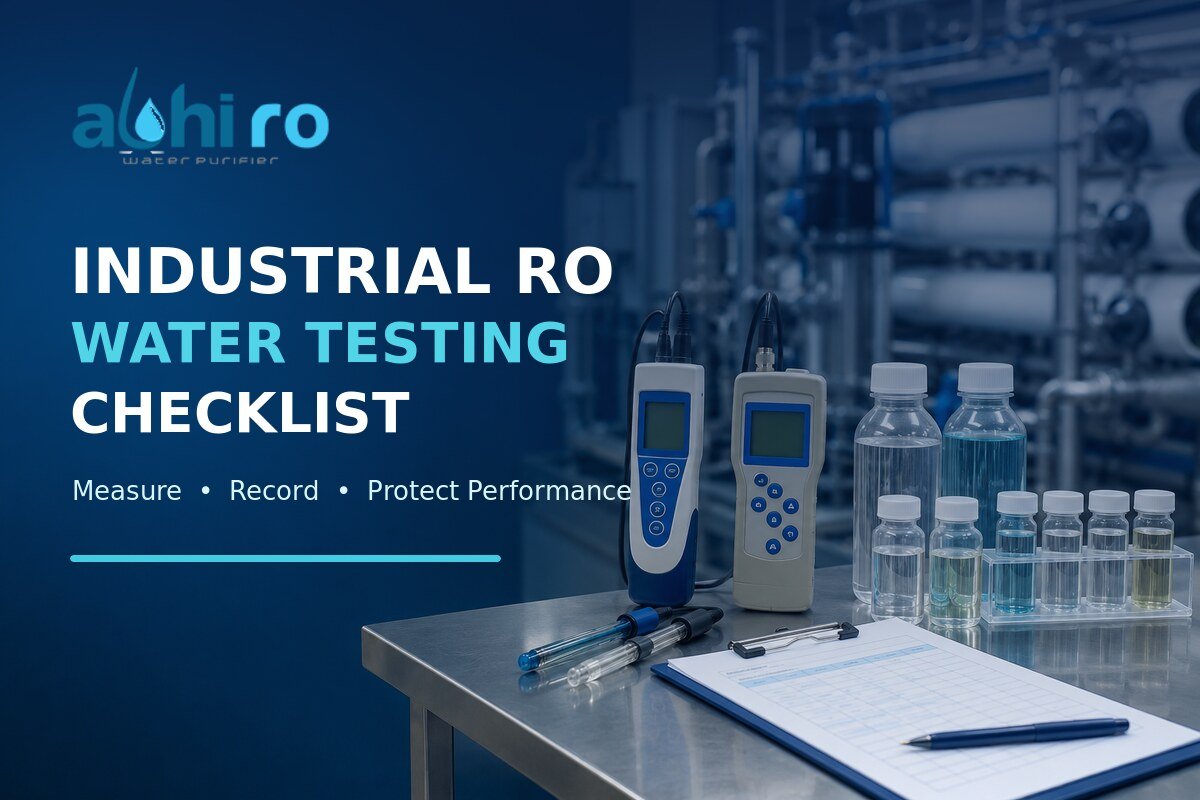
This industrial RO water testing checklist explains
what plant operators should measure, where samples should be collected
and how to use the results. It is intended as a practical monitoring
guide for factories, hotels, hospitals, institutions and commercial
water-treatment facilities in Coimbatore and across India.
Start with the correct
sampling points
A test result is meaningful only when the sample location is known.
At minimum, identify and label these points:
- Raw water before pretreatment
- RO feed water after pretreatment and chemical dosing
- Permeate or product water
- Concentrate or reject water
- Water after any final polishing or disinfection stage
Use clean sample containers and allow stagnant water in the sampling
line to flush before collecting a sample. Record the date, time, plant
status and sample point with every reading. Testing at random locations
without these details makes trend comparison difficult.
Daily operational
water-quality checks
The appropriate frequency depends on the plant design, source-water
variability and criticality of the application. The following parameters
are commonly useful for routine checks.
TDS or conductivity
Measure feed and permeate conductivity or TDS under stable operating
conditions. The relationship between the two readings is more useful
than viewing either number in isolation. A gradual rise in permeate
conductivity can indicate a change in feed water, membrane condition,
seals, recovery or operating pressure.
Use the same instrument and measurement basis consistently. TDS
displayed by many meters is calculated from conductivity using a
conversion factor, so values from different meters may not be directly
comparable. ABHIRO supplies handheld
and online water meters for routine plant monitoring.
pH
Feed-water pH influences scaling tendency, chemical dosing and
membrane performance. Permeate pH may differ from feed pH and should be
assessed according to the intended use of the treated water. Calibrate
the pH meter with suitable fresh buffers and follow the instrument
manufacturer’s procedure.
Do not adjust chemical dosage simply to chase a single pH reading.
Confirm the sample point, calibration and process conditions first.
Hardness
Hardness testing is especially valuable when a softener is used
before the RO system. A hardness increase after the softener can
indicate exhausted resin, inadequate regeneration, brine-system trouble,
channeling or an incorrect valve sequence. Detecting hardness leakage
early can help reduce scale risk downstream.
Free chlorine or other
oxidant residual
Many polyamide RO membranes can be damaged by oxidants. Where
chlorine is used upstream, test at the relevant points before the
membrane and verify that the dechlorination stage is functioning. The
acceptable residual and corrective action must follow the membrane and
system supplier’s requirements; one universal limit should not be
assumed for every installation.
Turbidity and SDI where
applicable
Turbidity provides a quick indication of suspended matter but does
not replace a fouling-potential assessment. For plants where particulate
fouling is a concern, the Silt Density Index may be monitored according
to the system designer’s method. A rising trend should prompt inspection
of media filters, cartridge filters, backwashing and source-water
conditions.
Weekly and periodic checks
Some tests need not be performed every shift, but they are important
when source water changes or deposits are suspected.
Alkalinity,
calcium and related scale-forming ions
Alkalinity and hardness data help assess carbonate scaling risk.
Depending on the source water, analysis may also include sulphate,
silica, barium, strontium, iron or manganese. Antiscalant selection and
dosage should be based on a current water analysis, RO recovery and
supplier projection—not on guesswork.
Explore ABHIRO’s RO
treatment chemicals when reviewing dosing requirements for a
commercial or industrial plant.
Iron and manganese
Iron and manganese can foul pretreatment equipment and membrane
surfaces. Results should be interpreted together with sample appearance,
oxidation conditions and the treatment process. If readings increase,
investigate the source and pretreatment rather than relying only on more
frequent cartridge replacement.
Microbiological indicators
Microbial testing may be required for drinking-water, food,
healthcare and other hygiene-sensitive applications. A field
presence/absence test can support screening, but it does not replace an
accredited laboratory or statutory testing where formal compliance is
required. ABHIRO’s range includes water
testing kits and bacteria test kits for different monitoring needs.
Record operating
data with every water test
Water chemistry is only one part of RO troubleshooting. Record these
operating values at the same time:
- Feed, concentrate and permeate pressure
- Permeate and concentrate flow
- Feed temperature
- Recovery or flow balance
- Differential pressure across pretreatment and membrane stages
- Chemical-dosing pump setting and solution preparation details
- Filter change, backwash and softener-regeneration history
Comparing normalized or like-for-like data is important because
temperature, feed salinity and pressure affect RO output. A single
low-flow reading on a colder day does not automatically prove membrane
fouling.
Turn readings into a
useful trend log
Create a simple sheet with one row for each observation and fixed
columns for sample point, instrument, result and operating condition.
Establish the normal range after commissioning and review trends instead
of reacting to isolated measurements.
Investigate when several indicators move together. For example,
rising feed hardness, increasing differential pressure and declining
permeate flow point to a different problem than stable pressures with a
sudden rise in permeate conductivity. Confirm instruments and repeat
unusual tests before changing chemicals or replacing components.
Common testing mistakes to
avoid
- Testing only the permeate and ignoring the feed
- Using meters that have not been calibrated or maintained
- Comparing readings from different sample points as if they were
identical - Recording values without the plant’s pressure, flow and
temperature - Changing chemical dosage after one abnormal reading
- Using expired reagents or contaminated sample containers
- Treating a field kit as a substitute for required laboratory
compliance testing - Failing to document maintenance actions beside the trend data
Frequently asked questions
How often should
industrial RO water be tested?
Critical operating parameters may be checked daily or per shift,
while broader chemistry can be tested weekly, monthly or when source
conditions change. The correct frequency depends on plant risk, water
variability, application and the system supplier’s operating plan.
Is a TDS meter enough for
an RO plant?
No. TDS or conductivity is valuable for monitoring salt passage, but
it does not directly show hardness, chlorine, silica, iron, microbial
contamination or particulate fouling potential.
Where should RO feed
water be sampled?
Collect it after the pretreatment and dosing stages, as close as
practical to the RO membrane inlet. Keep a separate raw-water sampling
point so pretreatment performance can be compared.
Can test
results determine the antiscalant dose?
Water analysis is an essential input, but dosage also depends on
recovery, membrane arrangement, temperature, pH and the chemical
supplier’s projection. Use verified design data and follow the selected
product’s guidance.
When should an
outside laboratory be used?
Use an appropriate laboratory for regulatory compliance, detailed
source-water analysis, unexplained plant problems, confirmation of field
results and parameters that cannot be measured reliably on site.
Build a
practical monitoring kit for your RO plant
ABHIRO Water Purifier supplies water testing kits, pH and TDS meters,
online controllers, RO chemicals, dosing equipment and industrial RO
components in Coimbatore. Share your source water, plant capacity,
application and current monitoring method, and our team can help
identify a practical set of tests and instruments.
Call or WhatsApp +91 99430 99998, or explore
ABHIRO’s industrial
and commercial RO solutions before planning your monitoring
routine.
Explore more practical guides in the ABHIRO Water Treatment Knowledge Centre, covering industrial RO systems, membranes, water testing, maintenance, treatment chemicals and water-treatment components.
For plant monitoring equipment: ABHIRO supplies RAKIRO water-test kits, handheld meters and online controllers for industrial RO applications. View RAKIRO testing products and request a quotation.
Need a Water-Test Kit or Meter for Your RO Plant?
For application-based selection, see the Water Test Kit Selection Guide and browse RAKIRO water-test kits and meters. For a quotation, share the parameter, expected range, number of tests or quantity and delivery location.