
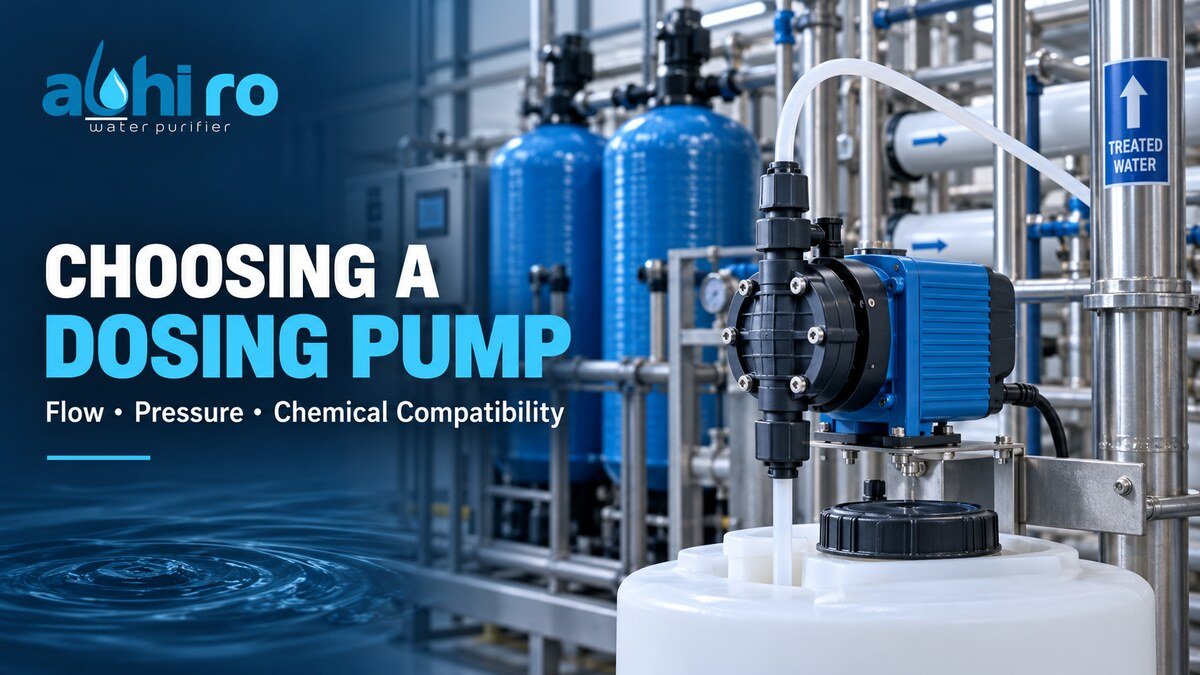
A chemical dosing pump may be small compared with an industrial RO plant, but its job is critical. It must inject a controlled quantity of antiscalant, disinfectant, pH-adjusting chemical or another treatment solution into a flowing water line. Choosing a pump only by its maximum litres-per-hour rating can lead to unstable dosing, frequent air locks, damaged wetted parts or poor treatment performance.
For factories, commercial buildings and water-treatment professionals in Coimbatore and across India, a suitable pump should be selected from actual process conditions. This guide explains the practical information to collect before choosing a chemical dosing pump for water treatment.
First Define the Dosing Purpose
Start with the chemical and the treatment objective. Common water-treatment applications include:
- antiscalant dosing before an RO membrane;
- sodium hypochlorite dosing for controlled disinfection;
- acid or alkali dosing for pH correction;
- coagulant dosing before clarification or filtration; and
- boiler, cooling-water, ETP and STP chemical treatment.
Each duty creates different requirements. A chemical may be corrosive, viscous or prone to releasing gas. Never assume that a pump suitable for one chemical can automatically be transferred to another.
Calculate the Required Dosing Rate
The pump flow should be based on the water flow, required chemical dose and concentration of the prepared solution. For a simple starting estimate:
Dosing solution flow (L/h) = water flow (m³/h) × required dose (mg/L) ÷ solution concentration (g/L)
Choose a pump whose normal operating point sits comfortably within its adjustable range. A greatly oversized pump may operate at a very low setting, making accurate adjustment difficult. A pump with no spare capacity may be unable to accommodate changes in feed-water quality or plant flow.
Match the Pump to Injection Pressure
Pump capacity is not independent of pressure. A model advertised at a particular flow may deliver a different output at the actual discharge pressure. The pump must overcome the pressure in the injection line, along with losses through tubing, valves and the injection fitting.
Before buying, confirm:
- pressure at the injection point during normal and peak operation;
- the pump’s rated flow at that pressure;
- tubing length, elevation and connection size;
- whether a back-pressure or pressure-relief arrangement is required; and
- the safe pressure rating of every component in the dosing line.
Request the manufacturer’s performance curve instead of relying only on the headline pump capacity.
Check Chemical Compatibility of Wetted Parts
The pump head, diaphragm, seals, valve balls, valve seats, tubing and injection valve all contact the dosing solution. Their materials must be compatible with the exact chemical, concentration and temperature used at site. Compatibility can change when a chemical is diluted or when operating temperature rises.
Share the chemical name, product data or safety data sheet, solution concentration and temperature with the pump supplier. Obtain a written material recommendation where possible. Chemical-resistant gloves, eye protection, ventilation and safe storage should follow the chemical manufacturer’s safety guidance.
Choose the Right Control Method
The simplest pump uses manual stroke-length or frequency adjustment and delivers a fixed rate while running. This can suit a plant with stable flow and trained operators. Applications with changing water demand may benefit from proportional control.
Common control approaches include:
Manual adjustment can suit a stable plant with trained operators. A pulse or analogue signal from a flow meter can adjust dosing when demand varies. Feedback control can use a measured parameter such as pH or ORP, but sensor placement, calibration, mixing time and control tuning remain essential.
ABHIRO offers a range of industrial dosing pumps with different capacities and control options for water-treatment duties.
Plan the Solution Tank and Suction Side
Many dosing problems begin before the chemical reaches the pump. Install the pump close to the solution tank with a short, airtight suction line. Avoid unnecessary bends and excessive suction lift. Fit the correct foot valve or strainer, and make sure the suction tubing does not curl above the liquid level and trap air.
The solution tank should be compatible, clearly labelled and protected from contamination. Prepare solutions consistently and record the chemical weight, final volume and date.
Provide suitable containment. Never mix acids with hypochlorite solutions or use an unlabelled container.
Design the Injection Point Correctly
Use an injection valve or quill designed for the line and position it where the chemical can mix effectively. Avoid injecting a chemical where it can immediately contact an incompatible chemical, damage nearby equipment or create a highly concentrated stagnant pocket.
For RO antiscalant, the injection point is generally located upstream of the cartridge filtration and membrane system after relevant pretreatment stages, but the correct arrangement depends on the plant design and chemical supplier’s guidance. ABHIRO’s RO treatment chemical range can be matched with an appropriate dosing arrangement after reviewing the application.
Calibrate Instead of Trusting the Dial Alone
The scale on a pump is a setting reference, not proof of actual delivery. After installation, measure the real output under operating conditions using a calibration column or another safe, approved method. Record the volume delivered over a known time and adjust the pump accordingly.
Recheck calibration after changing solution strength, servicing valves, altering pressure or replacing tubing. Also inspect for leaks, crystallisation, blocked injection fittings, air bubbles and loose connections. A simple log of pump setting, solution preparation and treated-water flow makes troubleshooting much easier.
Common Selection and Installation Mistakes
- Selecting only by maximum LPH without checking discharge pressure.
- Oversizing the pump and operating permanently at its lowest setting.
- Ignoring chemical compatibility of seals, tubing and valves.
- Using long or leaking suction lines that allow air to enter.
- Dosing into a poorly chosen point with inadequate mixing.
- Changing solution concentration without recalculating the pump setting.
- Running the pump dry or without a working foot valve.
- Skipping calibration and relying only on the control dial.
Chemical Dosing Pump Buying Checklist
Before requesting a quotation, provide the water flow, operating hours, chemical name, required dose, prepared-solution strength, injection pressure, temperature, control signal and available power supply. Also mention whether the plant needs manual control, flow proportional dosing, pH or ORP feedback, low-level interlock or remote alarm integration.
This information allows the pump, accessories and control method to be selected as one complete dosing system—not as unrelated components.
Frequently Asked Questions
Can one dosing pump be used for different chemicals?
Only after confirming compatibility of every wetted part and thoroughly following an approved cleaning and changeover procedure. Dedicated pumps are often safer where chemicals are incompatible or contamination could affect treatment.
Why does a dosing pump lose prime?
Common causes include an empty tank, air leaks on the suction side, a blocked foot valve, worn valve components, gas-forming chemicals, excessive suction lift or incorrect installation. Inspect the full suction path before increasing the setting.
How often should a dosing pump be calibrated?
Calibrate during commissioning and recheck at intervals appropriate to the process risk and manufacturer guidance. Recalibrate whenever the solution, pressure, pump components or operating conditions change.
Is a pH controller always required for pH dosing?
Not always. The need depends on water-flow variation, buffering capacity, process tolerance and operator control. Variable systems generally benefit from feedback control designed with suitable sensor placement and mixing time.
Get Help Selecting a Dosing Pump in Coimbatore
ABHIRO Water Purifier supplies dosing pumps, treatment chemicals, instruments and industrial RO components for customers in Coimbatore and across India. Share your water flow, chemical details, injection pressure and control requirement with our team for a suitable recommendation. Contact ABHIRO or call +91 99430 99998 to discuss your application.
Explore more practical guides in the ABHIRO Water Treatment Knowledge Centre, covering industrial RO systems, membranes, water testing, maintenance, treatment chemicals and water-treatment components.
How to calibrate a chemical dosing pump
A dosing pump should be calibrated against actual delivered volume rather than relying only on the percentage shown on the pump dial.
- Prime the pump and remove air from the suction/discharge line.
- Use a calibrated cylinder or calibration column with a known starting volume.
- Run the pump for a measured time at the intended stroke/speed setting and operating backpressure.
- Measure the volume delivered.
- Actual dosing rate = delivered volume ÷ elapsed time.
- Repeat the measurement until the result is stable, then record the setting and actual flow.
Recalibrate after maintenance, diaphragm replacement, loss of prime, major backpressure changes, changes in chemical viscosity/concentration or unexpected chemical consumption.
