
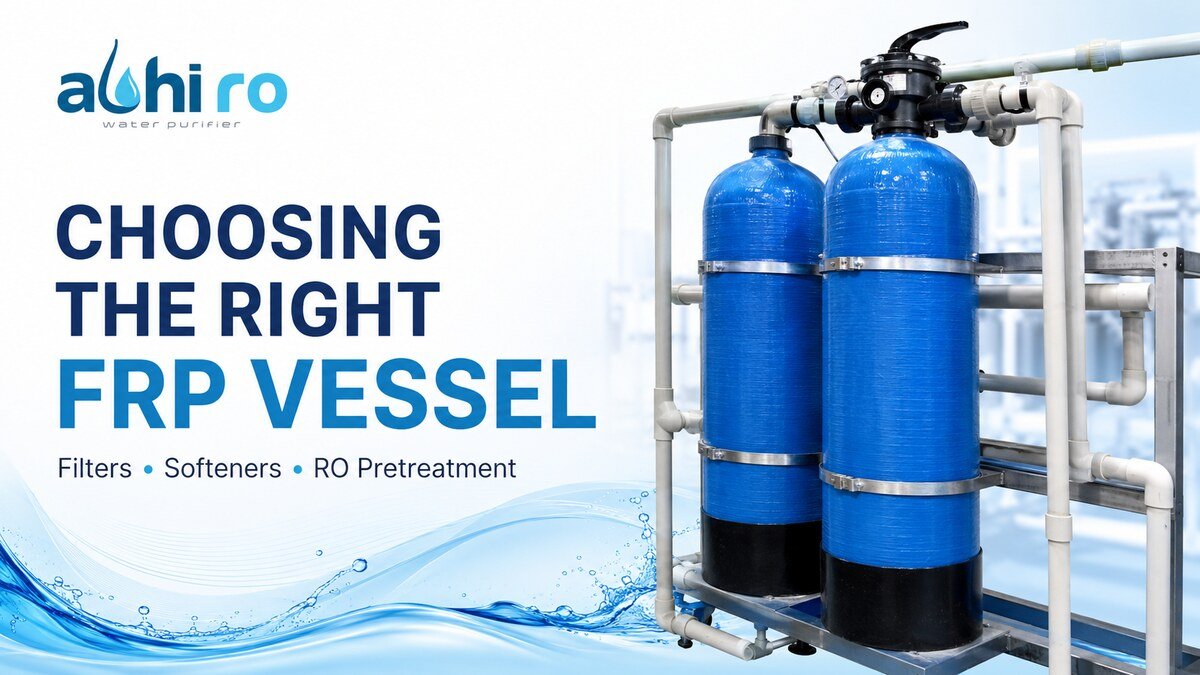
An FRP vessel is a key part of many pressure filters, water softeners and reverse-osmosis pretreatment systems. It holds the filtration media or softening resin while water passes through under pressure. Choosing the vessel only by its outside dimensions can create problems: insufficient service flow, frequent backwashing, high pressure loss or poor media performance.
For homes, commercial buildings and industries in Coimbatore, the right choice depends on water quality, required flow, treatment process and available installation space. This guide explains the practical checks to make before buying an FRP vessel for water treatment.
What Is an FRP Pressure Vessel?
FRP means fibre-reinforced plastic. A typical water-treatment vessel combines a corrosion-resistant inner liner with a reinforced outer structure. Unlike an ordinary storage tank, it is designed to contain filter media and operate as part of a pressurised treatment line.
FRP vessels are commonly used for:
- pressure sand and multimedia filters;
- activated-carbon filters;
- iron-removal filters;
- ion-exchange water softeners;
- RO and UF pretreatment; and
- selected commercial and industrial filtration duties.
Their relatively low weight can simplify handling, while the non-metallic construction avoids rust. However, the vessel, valve, internal distributor and media must be selected as one working system.
Start With Water Analysis and Treatment Purpose
The first question is not “Which vessel size is popular?” It is “What must the system remove?” Turbidity and suspended solids may require graded filtration media. Chlorine, taste and odour usually call for activated carbon. Hardness requires a correctly sized softener and resin volume. Iron removal depends on iron concentration, water chemistry and the selected process.
A representative water test helps the designer estimate contaminant loading and decide the required media depth, contact time and cleaning frequency. The same vessel can perform very differently when filled with different media.
For RO plants, pretreatment should be designed around the raw-water analysis and the membrane system’s feed requirements. Good pretreatment reduces fouling pressure on downstream cartridge filters and membranes; it does not replace routine monitoring.
Match Vessel Diameter to Service Flow
Vessel diameter determines the cross-sectional area available for water flow. If the service rate is too high for that area, water may move through the media too quickly, increasing pressure loss and reducing effective treatment. A larger diameter generally provides more area, but it also needs more media, more backwash water and more floor space.
Ask the supplier to size the vessel using:
- normal and peak flow in litres per hour;
- the selected media’s recommended service velocity;
- expected inlet pressure and acceptable pressure drop;
- daily operating hours; and
- whether demand is continuous or intermittent.
Do not use only the RO plant’s product-water rating. Pretreatment flow may need to cover the RO feed and account for reject water, flushing and other operating conditions.
How to Estimate Media Bed Volume
For preliminary sizing, the cylindrical part of a vessel can be treated as a simple bed-volume calculation:
Bed volume = vessel cross-sectional area × media bed depth
For a circular vessel, cross-sectional area = π × diameter² ÷ 4. Use internal dimensions and consistent units. This gives a geometric estimate only; actual media loading must still account for vessel dome volume, distributor arrangement, support gravel where used, freeboard and the media manufacturer’s recommended bed depth.
Do not fill the full vessel volume with media. Backwash expansion requires freeboard, and different media have different expansion characteristics and loading densities. The final quantity should therefore be checked against the vessel and media supplier’s data rather than calculated from gross vessel litres alone.
Confirm Media Volume, Freeboard and Bed Depth
The vessel must hold the required media while leaving free space above the bed. This freeboard allows the media to expand during backwashing. Filling a vessel to the top can prevent proper cleaning and may carry media into the valve or drain line.
Different media expand by different amounts, so there is no universal fill percentage. Use the media manufacturer’s loading and backwash guidance. Also confirm the under-bed support arrangement, distributor tube length and any gravel requirement before installation.
If you are comparing media options, see ABHIRO’s water filter media range.
Check the Backwash Requirement
Backwash is often the deciding factor in vessel selection. The pump must provide enough flow to expand and clean the bed without washing media out of the system. Inadequate backwash allows dirt to accumulate, causing channeling, pressure loss and shorter filter runs.
Before finalising the design, verify:
- the required backwash rate for the chosen media;
- whether the feed or dedicated backwash pump can deliver it;
- the drain line size and discharge capacity;
- the availability of clean water for backwash and rinse; and
- the acceptable time between cleaning cycles.
Where water availability is limited, a designer may consider staged filtration or multiple smaller vessels, but the decision should be based on hydraulic calculations rather than convenience alone.
Select the Correct Valve and Opening
The multiport valve controls service, backwash and rinse paths. Softener valves may also manage brine draw and regeneration. Valve flow capacity, connection size and operating sequence must match the vessel and treatment duty.
A manual multiport valve can suit installations with trained operators and predictable maintenance. An automatic multiport valve can reduce manual intervention by initiating cycles on a programmed schedule or according to the controller’s available functions.
Confirm whether the design needs a top-mount or side-mount arrangement and whether a top-only or top-and-bottom opening is preferable for media loading, servicing and distributor access. Never assume that valves and vessel threads are interchangeable.
Plan for Installation Conditions in Coimbatore
Industrial sites around Coimbatore can have very different borewell quality, dust exposure, pump arrangements and space constraints. Check the actual site before ordering.
Provide a level base, adequate headroom, access for media replacement and room to operate or service the valve. Support external piping independently so its weight does not strain the vessel connection. Protect equipment from impact and unsuitable heat exposure, and follow the vessel and valve manufacturers’ pressure and temperature limits.
Pressure gauges before and after the filter make it easier to track differential pressure. Sampling points also help operators check whether the treatment stage is doing its job.
Explore ABHIRO’s FRP vessel range when planning a new filter, softener or RO pretreatment train.
Common Buying Mistakes to Avoid
- Choosing by vessel volume without checking service and backwash flow.
- Using an undersized valve that restricts the system.
- Overfilling the vessel and leaving inadequate freeboard.
- Ignoring the pump’s backwash capability.
- Mixing unmatched threads, distributors or valve fittings.
- Installing without pressure gauges, bypass provisions or service access.
- Reusing old media without checking condition and suitability.
FRP Vessel Selection Checklist
Before requesting a quotation, share the raw-water report, required treated-water flow, operating hours, treatment objective, pump pressure, preferred automation level and available space. Also state whether the project is new or a replacement, because existing pipe sizes and valve connections may affect compatibility.
A technically complete enquiry helps the supplier recommend a vessel, valve, distributor and media combination instead of quoting an isolated component.
Frequently Asked Questions
Is an FRP vessel the same as a water storage tank?
No. An FRP pressure vessel in a treatment plant normally contains filtration media or resin and operates in a pressurised line. A storage tank serves a different purpose.
Can one vessel be used for sand, carbon or softener resin?
The vessel body may be suitable for several duties, but the media quantity, internals, valve sequence, flow rate and backwash requirements differ. The complete assembly must be designed for the selected process.
Is a bigger FRP vessel always better?
No. Oversizing can increase media cost, backwash demand and space requirements. Undersizing can cause high velocity and poor performance. Correct hydraulic and media sizing is more important than choosing the largest model.
When should I choose an automatic multiport valve?
Automation is useful when consistent scheduled cleaning, reduced operator handling or unattended operation is important. The controller and valve still need correct programming, inspection and maintenance.
How can ABHIRO help with vessel selection?
ABHIRO Water Purifier can review your water analysis, flow requirement, treatment goal and site constraints to help identify a suitable FRP vessel, valve and media arrangement for projects in Coimbatore and across India.
Get a Practical Selection Recommendation
Planning a pressure filter, softener or RO pretreatment system? Contact ABHIRO Water Purifier with your water-test results and required flow. A system-level review can help you avoid mismatched components and build a filtration stage that is easier to operate and maintain.
Explore more practical guides in the ABHIRO Water Treatment Knowledge Centre, covering industrial RO systems, membranes, water testing, maintenance, treatment chemicals and water-treatment components.
