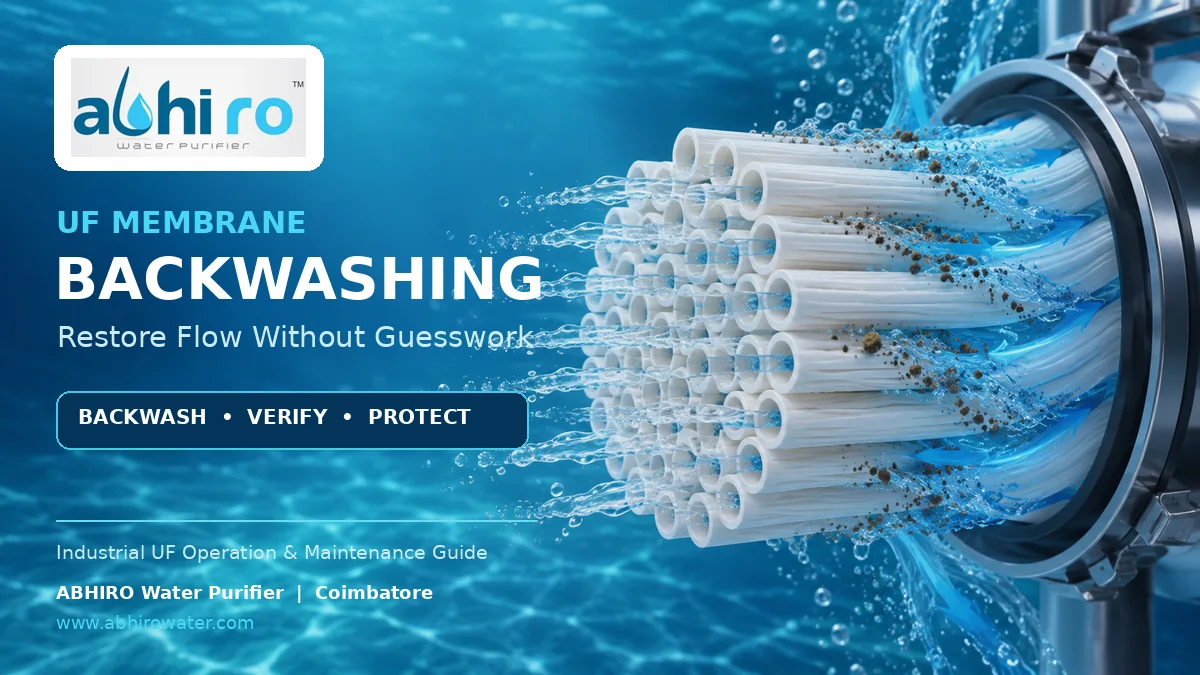
UF membrane backwashing should be based on operating trends, not a fixed guess. Watch transmembrane pressure, filtrate flow and filtrate quality at comparable operating conditions. A controlled reverse-flow backwash can remove reversible deposits, but repeated loss of performance after backwashing indicates that pretreatment, air scouring, chemical cleaning, valves, instruments or membrane condition needs investigation.
What You Will Learn
- What UF backwashing actually does
- Which signs should trigger attention
- A practical backwash sequence
- How to verify recovery after backwashing
- When backwashing is not enough
- Common operating mistakes
- Frequently asked questions
What UF Membrane Backwashing Actually Does
Backwashing reverses clean water through the membrane for a controlled period to dislodge material accumulated on or near the membrane surface. Depending on the system design, it may be combined with draining, forward flushing or air scouring. It is intended for reversible fouling; it is not a substitute for correct pretreatment or a cure for damaged fibres.
The correct direction, flow, pressure, duration and sequence are specific to the installed membrane and skid. Operators should follow the membrane supplier’s manual and the plant designer’s settings rather than copying values from another installation. ABHIRO’s UF systems page is the main cluster page for customised ultrafiltration enquiries in Coimbatore and India.
Signs That a UF System Needs Attention
A rising transmembrane pressure or falling filtrate flow at similar temperature and operating conditions is more useful than a calendar alone. A scheduled backwash may still be appropriate, but trend data shows whether the interval remains suitable as feed-water quality changes.
- Rising transmembrane pressure: resistance is increasing across the membrane.
- Falling filtrate flow: output declines even though feed conditions and valve positions are comparable.
- Shorter stable run time: the system reaches its cleaning trigger sooner after each cycle.
- Filtrate-quality change: turbidity or particle breakthrough requires immediate investigation rather than simply increasing backwash frequency.
- Uneven pressure or flow: a blocked line, faulty valve, air lock or instrument error may imitate membrane fouling.
Record feed and filtrate pressure, flow, temperature, turbidity where monitored, backwash frequency and any pretreatment changes. The related industrial water-testing checklist provides a useful framework for consistent sampling and operating records.
Practical UF Backwash Sequence
Use the programmed sequence approved for the installed UF system. The following workflow explains the logic of a typical cycle, but it does not replace the equipment manual or site safety procedure.
- Confirm conditions. Check the trigger, feed-water condition, tank level and availability of suitable backwash water.
- Stop filtration safely. Allow pumps and automatic valves to change state in the designed sequence.
- Drain or relax if specified. Some systems include a short drain or relaxation step before reverse flow.
- Backwash at the approved setting. Use the specified source, direction and hydraulic limits; do not raise pressure to force a faster recovery.
- Use air scour only if designed. Incorrect air flow can stress fibres or create unstable operation.
- Forward flush where required. Remove loosened material before returning filtrate to service.
- Restart and stabilise. Allow readings to settle before judging the result.
- Record the outcome. Compare post-backwash pressure, flow and water quality with the clean baseline.
How to Verify Recovery After Backwashing
A successful backwash should move the system back towards its established baseline under comparable conditions. Do not judge success from a pressure reading taken at a different flow or immediately after an unstable restart.
- Compare transmembrane pressure at the same or a normalized filtrate flow.
- Check that filtrate flow recovers without exceeding the approved operating limits.
- Confirm filtrate turbidity or other site quality indicators before routing water to service.
- Verify that valves returned to the correct position and no drain valve remains partly open.
- Track how long stable operation continues before the next cleaning trigger.
If the plant is used as RO pretreatment, link the UF log with downstream cartridge-filter differential pressure and RO performance. ABHIRO’s industrial RO pressure-drop guide helps isolate restrictions after the UF stage.
When Routine Backwashing Is No Longer Enough
Escalate the investigation when recovery becomes progressively weaker, the interval between backwashes keeps shrinking or filtrate quality fails to stabilise. Repeating hydraulic backwash more aggressively can waste water and may exceed the membrane’s limits without addressing the underlying problem.
- Review raw-water turbidity, organics, biological activity and upstream chemical changes.
- Inspect strainers, pumps, valve actuation, flow meters and pressure instruments.
- Confirm that the backwash-water source is suitable and not reintroducing solids.
- Check whether the installed cleaning programme requires maintenance cleaning or chemical-enhanced backwash.
- Use only membrane-compatible chemicals, concentrations, temperatures and contact times approved for the installed element.
- Investigate possible fibre damage if filtrate quality deteriorates despite normal hydraulic readings.
Common UF Backwashing Mistakes
The most common mistake is changing several settings at once without recording the baseline. That makes it difficult to identify whether the real cause was fouling, feed-water change, valve operation or unreliable instrumentation.
- Copying another plant’s backwash time or pressure.
- Using untreated or dirty water for backwashing.
- Increasing backwash pressure beyond the approved limit.
- Ignoring temperature when comparing flow and pressure trends.
- Skipping pretreatment inspection when fouling returns quickly.
- Sending initial restart water to service before quality stabilises.
- Using cleaning chemicals without confirming membrane compatibility.
Frequently Asked Questions
How often should a UF membrane be backwashed?
There is no universal interval. Use the approved control sequence and adjust only after reviewing feed-water variability, transmembrane pressure, filtrate flow, water quality and the membrane supplier’s limits.
Can RO permeate be used for UF backwashing?
Some systems use filtrate or another suitable clean-water source. The correct source depends on the design, water balance and membrane instructions. Confirm compatibility and availability before changing the arrangement.
Does backwashing remove all UF membrane fouling?
No. Hydraulic backwashing mainly targets reversible deposits. Persistent organic, biological or mineral fouling may require an approved maintenance or chemical cleaning procedure.
Why does UF flow fall again soon after backwashing?
Possible causes include deteriorating feed water, inadequate pretreatment, incomplete backwashing, valve or pump faults, unsuitable operating flux, irreversible fouling or damaged fibres. Diagnose the trend instead of only shortening the cycle.
Get UF System Support in Coimbatore
ABHIRO Water Purifier supplies and supports customised UF systems and related industrial water-treatment components. For practical assistance, share the raw-water report, system capacity, membrane details, operating pressures, feed and filtrate flow, backwash sequence and recent trend data through the ABHIRO contact page.