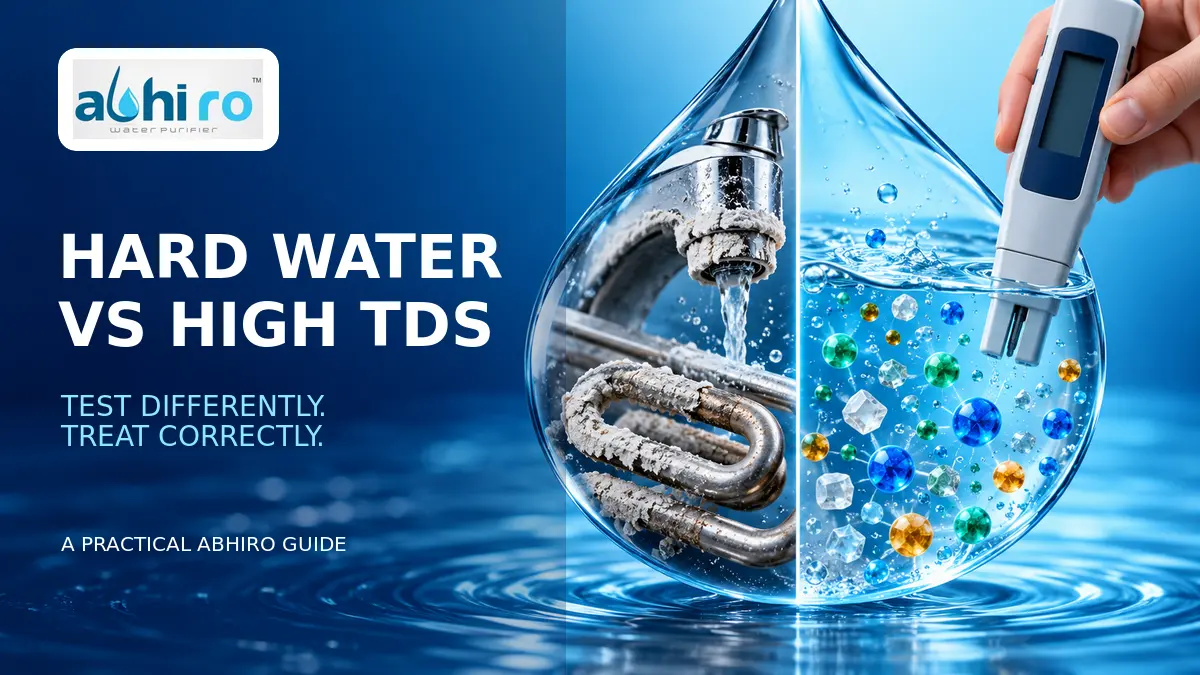
Hard water and high TDS are not the same problem. Hardness mainly measures dissolved calcium and magnesium, while total dissolved solids (TDS) represents a wider group of dissolved ions. A softener controls hardness-related scale; reverse osmosis reduces a broader dissolved-solids load. Test both parameters before choosing equipment, because one reading cannot reliably substitute for the other.
What You Will Learn
- What hardness and TDS measure
- The practical differences
- What the common signs can tell you
- How to test each parameter
- When to choose a softener, RO or both
- A step-by-step treatment decision
- Common buying mistakes
- Frequently asked questions
What Water Hardness and TDS Actually Measure
Water hardness is a specific measurement, whereas TDS is a broad estimate. Hardness mainly reflects calcium and magnesium ions. These minerals can form scale when water is heated or concentrated, and they also interfere with soap lathering. The U.S. Geological Survey explains water hardness in the same calcium-and-magnesium terms.
TDS includes many dissolved ions, potentially including calcium, magnesium, sodium, chloride, bicarbonate and sulphate. A handheld TDS meter usually estimates TDS from electrical conductivity; it does not identify which individual substances are present. Therefore, two water samples with the same TDS reading may behave very differently.
Hard Water vs High TDS: The Key Differences
| Question | Hardness | TDS |
|---|---|---|
| What does it represent? | Mainly calcium and magnesium | A broader dissolved-ion load |
| Typical test | Hardness titration or test kit | Calibrated conductivity/TDS meter |
| Common operational issue | Scale and poor soap performance | Taste or process-quality concerns, depending on composition |
| Usual treatment | Ion-exchange softener | RO when lower dissolved solids are required |
| Does one reading replace the other? | No | No |
A water softener exchanges hardness ions for other ions and may leave the overall conductivity or TDS similar. RO, in contrast, separates a broad range of dissolved ions into permeate and reject streams. That is why selecting equipment from a TDS reading alone can miss a serious scaling issue.
What the Common Signs Can—and Cannot—Tell You
White scale is a strong reason to test hardness, but appearance alone is not a complete diagnosis. In homes, apartments and businesses around Coimbatore, water quality can vary by borewell, municipal supply, tanker source and season. A change of source can therefore change the treatment need.
- Possible hardness signs: white crust on taps or heaters, spotting on glass, reduced soap lather and scale inside hot-water equipment.
- Possible high-TDS signs: unusual mineral or salty taste and a high meter reading. The reading alone does not reveal which ions are responsible.
- Not proof of safety: a clear appearance or a low TDS number does not test for bacteria, pesticides or every chemical contaminant.
How to Test Hardness and TDS Correctly
Use separate, suitable methods for hardness and TDS. ABHIRO offers water testing kits and water meters, but instrument selection should match the parameter, range and accuracy needed.
- Collect a fresh sample in a clean container after allowing stagnant water to clear from the line.
- Measure TDS with a clean, calibrated conductivity/TDS meter and follow its operating instructions.
- Measure total hardness with an appropriate hardness test kit or send a representative sample to a qualified laboratory.
- Record the water source, date, sampling point and whether the supply recently changed.
- For equipment design, request a broader analysis when other parameters may affect scaling, corrosion, taste or process suitability.
Water Softener, RO or Both: Which Treatment Fits?
Choose treatment according to the required outcome—not the name of the source. A borewell is not automatically an RO case, and a high TDS reading does not automatically mean a softener will solve the concern.
Choose a Water Softener for Scale Control
An ion-exchange softener is appropriate when measured hardness is causing scale or poor soap performance across bathrooms, appliances, hot-water lines or a process. Review ABHIRO’s water softener range as the cluster’s pillar page.
Choose RO When Lower Dissolved Solids Are Required
RO is used when a drinking-water or process application requires a lower dissolved-solids concentration. System design must consider feed analysis, pressure, recovery, pretreatment and intended use. For household technology selection, see RO vs UV vs UF water purifier.
Use Both When the Objectives Are Different
A combined line may be appropriate when hard water must first be conditioned to reduce scaling risk and RO is then used to produce lower-TDS water. The order, capacity and controls should be designed from the water report and demand pattern, not copied from another site.
A Step-by-Step Treatment Decision
- Define the use: drinking, bathing, laundry, boiler feed, cooling, production or another process.
- Test the actual source: include hardness and TDS, then add application-specific parameters.
- Define the target: scale control and lower TDS are different goals.
- Measure demand: note peak flow, daily volume and operating hours.
- Select and size the process: account for regeneration, reject water, drainage, storage and maintenance.
- Verify after installation: retest treated water and monitor performance over time.
Common Buying Mistakes to Avoid
- Buying a softener only because the TDS meter reads high.
- Assuming a softener must reduce the TDS reading substantially.
- Choosing RO capacity without checking peak demand and feed quality.
- Treating a TDS reading as a complete drinking-water safety report.
- Using a sample from a different source or an unrepresentative storage tank.
Frequently Asked Questions
Can water have high TDS but low hardness?
Yes. Dissolved ions such as sodium and chloride can raise conductivity and estimated TDS without producing the same hardness caused by calcium and magnesium.
Does a water softener reduce TDS?
Not necessarily. A conventional ion-exchange softener replaces hardness ions rather than removing the overall dissolved-ion load, so the TDS reading may remain similar.
Does RO remove hardness?
RO can reduce hardness ions in product water, but hard feed water may scale membranes if pretreatment and operating conditions are unsuitable. Design should be based on analysis.
Is a TDS meter enough to choose a water purifier?
No. A TDS meter does not identify individual ions or detect every microbial and chemical risk. Consider the source, intended use and a suitable water analysis.
Get a Water-Based Recommendation from ABHIRO
Share your source-water report, application, required flow and daily demand with ABHIRO Water Purifier in Coimbatore. The team can help compare a water softener, RO system or combined treatment arrangement for your actual requirement. Contact ABHIRO to discuss testing and system selection.
Explore more practical guides in the ABHIRO Water Treatment Knowledge Centre, covering industrial RO systems, membranes, water testing, maintenance, treatment chemicals and water-treatment components.