
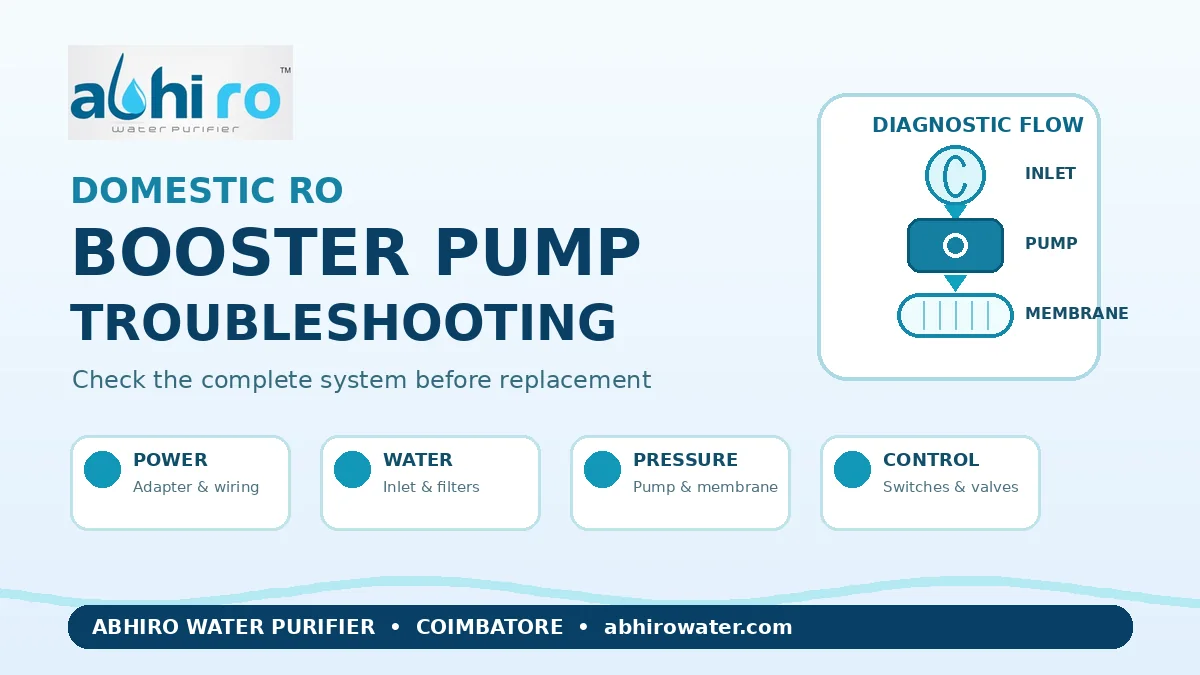
RO booster pump troubleshooting should begin with the symptom, not immediate pump replacement. Confirm the water supply, pre-filter condition, power adapter output, wiring, switches and tubing before testing pump pressure or flow. A pump that is silent, noisy, weak or continuously running can have different causes, and replacing it without checking the surrounding system may leave the original fault unresolved.
What You Will Learn
- What the booster pump does
- Safety checks before diagnosis
- Why the pump does not run
- Why pressure or production is low
- Why the pump is noisy or vibrating
- Why the pump runs continuously
- How to select a compatible replacement
- Frequently asked questions
What a Domestic RO Booster Pump Does
A domestic RO booster pump raises feed-water pressure so the membrane can produce permeate at the intended operating condition. It works as part of a system that includes the inlet valve, pre-filters, low-pressure switch, power adapter or SMPS, solenoid valve, membrane, flow restrictor, high-pressure switch, storage tank and tubing.
Because these parts interact, slow water production does not automatically prove that the pump is weak. A blocked sediment cartridge, low inlet pressure, unsuitable membrane, restricted tubing, faulty adapter or incorrectly sized flow restrictor can create similar symptoms. Browse ABHIRO’s domestic RO booster-pump category when identifying a compatible replacement.
Complete These Safety Checks First
Disconnect electrical power and close the feed-water valve before opening the purifier or loosening tubing. Water and electricity are present in the same enclosure, so testing should be handled by a trained service technician with suitable instruments.
- Switch off and unplug the purifier.
- Close the inlet water and relieve trapped pressure safely.
- Check for wet connectors, damaged insulation, burnt smell or overheated parts.
- Identify the pump voltage, current requirement, flow rating and connector polarity from its label.
- Do not bypass pressure switches or protection devices for normal operation.
When the RO Booster Pump Does Not Run
A silent pump usually points first to the electrical supply or an open control circuit. Confirm that the purifier is calling for water before condemning the motor.
- No mains supply: inspect the socket, plug, switch and fuse using approved test methods.
- Faulty SMPS or adapter: measure the DC output under load and compare it with the equipment rating.
- Low-pressure switch open: check the inlet supply, pre-filter restriction and switch operation.
- High-pressure switch open: a full tank may be normal; a faulty switch or blocked product line may not be.
- Loose or reversed connection: inspect terminals, polarity and wiring against the purifier diagram.
- Motor fault: consider the pump only after supply voltage and control continuity are verified.
When Pump Pressure or Water Production Is Low
Low RO production can come from restricted feed flow, low pressure, cold water, membrane condition or an incorrect hydraulic setting. Measure rather than judge only by how quickly the storage tank fills.
- Confirm that the inlet valve is fully open and source-water pressure is stable.
- Check sediment and carbon pre-filters for excessive restriction.
- Inspect tubing for kinks, flattened bends, leaks or incorrect connections.
- Measure adapter voltage while the pump is running; an unloaded reading alone can miss voltage collapse.
- Measure feed pressure at the membrane using a suitable gauge and safe connection.
- Compare permeate and reject flow with the purifier design and membrane instructions.
If product-water TDS has also increased, do not assume the pump alone is responsible. Use ABHIRO’s RO, UV and UF selection guide for treatment context and review the domestic RO membrane range only after verifying operating conditions.
When the Pump Is Noisy or Vibrating
Unusual noise often results from air, poor mounting or restricted suction rather than immediate motor failure. Stop the purifier if the pump becomes abnormally hot, smells burnt or leaks.
- Ensure the pump receives water and is not running dry.
- Purge trapped air according to the purifier manufacturer’s procedure.
- Check rubber mounts, screws and tubing contact with the cabinet.
- Look for a blocked inlet cartridge or partially closed valve.
- Check for pulsation caused by unstable water supply or a damaged diaphragm.
When the Pump Runs Continuously
A pump that never stops may indicate slow production, a leak, tank-pressure issues or a shutdown-control fault. Continuous operation can overheat components, so investigate promptly.
- Check whether the storage tank actually fills and whether water is leaking to drain.
- Inspect the automatic shut-off valve, solenoid valve and high-pressure switch.
- Confirm tank air pressure using the tank manufacturer’s method when the water side is empty.
- Check for low membrane production caused by pressure, temperature, fouling or membrane condition.
- Verify that the reject-flow restrictor matches the membrane and system design.
How to Select a Compatible Replacement Pump
A replacement pump must match the purifier as a system. Selecting only by a familiar GPD label can result in incompatible power demand, pressure, flow or mounting.
- rated DC voltage and current requirement;
- membrane capacity and intended operating pressure;
- inlet and outlet connection size;
- mounting-hole position and available cabinet space;
- permitted water temperature and feed-water condition;
- compatibility with the SMPS, switches, membrane and restrictor.
Share a clear photograph of the old label and purifier arrangement with the supplier. ABHIRO’s domestic RO systems category provides context for common purifier capacities, while final component selection should follow the actual model and installation.
Frequently Asked Questions
Can I test an RO pump directly with another adapter?
Only a qualified technician should perform a controlled test using a supply with the correct voltage, current capacity and polarity. An unsuitable adapter can damage the pump or create an electrical hazard.
Does a noisy RO pump always need replacement?
No. Air, dry running, restricted inlet flow, loose mounting or cabinet contact can create noise. Isolate the exact cause before replacing the pump.
Can a clogged pre-filter reduce pump pressure?
Yes. A heavily restricted pre-filter can reduce water reaching the pump, causing low output, noise or low-pressure-switch operation.
Should I replace the pump and membrane together?
Not automatically. Test pump supply, pressure, flows and membrane performance separately. Replace only the component shown to be unsuitable or defective.
Get Domestic RO Pump Support in Coimbatore
ABHIRO Water Purifier supplies domestic RO booster pumps, SMPS units, membranes, switches, valves and purifier spares for service technicians, dealers and users. For practical replacement guidance, contact ABHIRO in Coimbatore with the purifier model, old pump label, membrane capacity, symptoms and test readings.


