
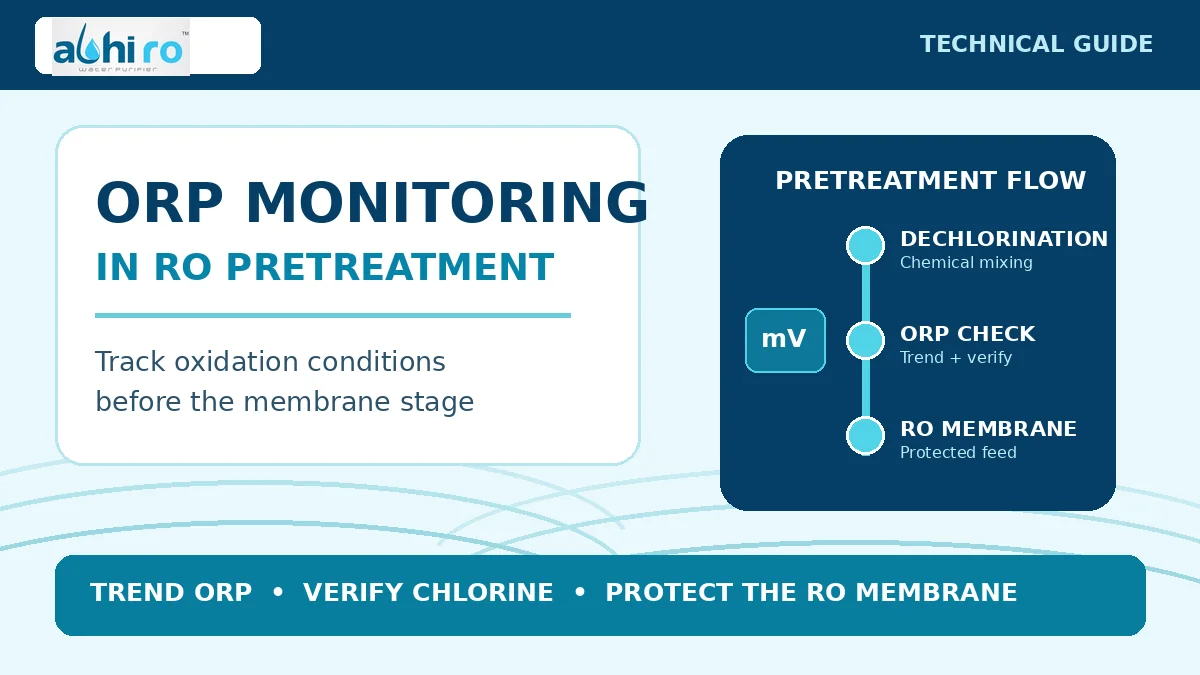
ORP monitoring in RO pretreatment helps operators see whether water conditions are becoming more oxidising or reducing before the membrane stage. It is valuable for trending chlorination and dechlorination, but it does not directly measure free chlorine. Use ORP together with a chlorine-specific test, stable sampling conditions and the membrane supplier’s operating limits—not as a stand-alone pass/fail alarm.
What You Will Learn
- What ORP measures in an RO plant
- Why ORP is monitored before RO membranes
- Where to locate the ORP sensor
- How to interpret ORP trends
- A practical monitoring procedure
- How to troubleshoot unreliable readings
- Frequently asked questions
What ORP Measures in an RO Plant
Oxidation-reduction potential (ORP) is an electrical potential, reported in millivolts, that indicates the overall tendency of water to accept or donate electrons. A more positive reading generally represents a more oxidising condition; a lower or negative reading represents a more reducing condition.
ORP is influenced by more than one chemical. Chlorine, reducing agents, pH, temperature, dissolved oxygen and other constituents can all affect the value. For that reason, an ORP meter is best treated as a process-trending instrument. It cannot tell an operator the exact free-chlorine concentration in mg/L.
Why ORP Is Monitored Before RO Membranes
The main purpose is to obtain an early, continuous indication of changing oxidation conditions before water reaches an oxidation-sensitive membrane. Many polyamide RO membranes require dechlorination upstream; the exact allowable exposure depends on the installed membrane and operating conditions.
- During chlorination: ORP can show whether the pretreatment water has moved toward a more oxidising condition.
- After dechlorination: a stable downward shift can support confirmation that reducing chemical is taking effect.
- During a process upset: a sudden rise near the RO feed can trigger investigation before membrane exposure continues.
- During offline sanitisation: ORP trending can help confirm that oxidising water has been rinsed from pretreatment before restart.
DuPont’s reverse-osmosis pretreatment guidance notes that dechlorination is required upstream of its membranes and describes ORP monitoring as one way to verify the absence of chlorine-containing feed after offline chlorination. This is useful technical context, not a substitute for the manual and warranty conditions of the membrane actually installed.
Where to Locate the ORP Sensor
Place the critical monitoring point after the dechlorination stage and before the high-pressure pump or membrane inlet, where it represents the water that will actually enter the RO array. The probe needs reliable flow, complete chemical mixing and convenient access for cleaning and calibration checks.
- Avoid dead legs, stagnant sample cups and locations immediately beside a chemical injection point.
- Provide adequate mixing and reaction time between dosing and measurement.
- Keep the sensor continuously wetted according to its instructions.
- Record the sample point so handheld and online readings are compared consistently.
- If chlorination is also monitored upstream, label the two points clearly to prevent confusion.
How to Interpret ORP Trends
The most useful ORP reference is the plant’s own verified baseline, not a universal number copied from another site. Source-water chemistry and pH vary across borewell, municipal and surface-water supplies in Coimbatore and elsewhere in India, so identical chlorine conditions can produce different ORP readings.
Build the baseline only when the plant is stable. Record ORP alongside free chlorine, pH, temperature, chemical dosing rate, flow and the operating state. Repeated paired readings show what “normal” looks like for that plant. Alarm limits should then be set with the system designer, membrane documentation and risk assessment.
A rising ORP after dechlorination may indicate oxidant breakthrough, insufficient reducing-agent dose, an empty chemical tank, loss of dosing-pump prime, poor mixing or a measurement problem. A falling value can indicate excess reducing conditions, but it can also result from chemistry or sensor changes. Confirm the cause before adjusting dose.
A Practical ORP Monitoring Procedure
Use a repeatable procedure that combines the online trend with an independent chemical test. This reduces the risk of responding to a dirty probe or an unrepresentative sample.
- Confirm stable operation. Note feed flow, chemical dosing, pH and temperature before judging the reading.
- Inspect the trend. Look for a sustained change rather than reacting to a single brief spike.
- Collect a representative sample. Use the established post-dechlorination point and flush the sample line.
- Test residual chlorine directly. Use an appropriate free- or total-chlorine method for the plant chemistry.
- Check the dosing system. Inspect tank level, suction line, pump prime, injection valve and mixing conditions.
- Verify the ORP instrument. Clean and check the electrode according to the manufacturer’s method.
- Record the finding and action. Log ORP, chlorine result, pH, temperature and any dose change.
For a broader schedule of feed, permeate and reject-water checks, use ABHIRO’s industrial RO water-testing checklist. Operators selecting portable or online instruments can also review the water meters category and the water-test kit selection guide.
How to Troubleshoot Unreliable ORP Readings
Slow, noisy or implausible readings commonly come from the measurement setup rather than an immediate change in water chemistry. Check the complete sample and sensor system before changing chemical dose.
- Coated electrode: clean it only with the method approved for that sensor.
- Dry or aged probe: follow storage and replacement guidance from the instrument manufacturer.
- Air bubbles or poor flow: correct the flow cell or installation so the sensing surface remains immersed.
- Changing pH or temperature: record both and compare readings under similar conditions.
- Electrical interference: inspect grounding, cables and separation from motors or variable-frequency drives.
- Poor chemical mixing: review injection-point location and available contact time.
If membrane performance has already changed, use the industrial RO troubleshooting guide to assess permeate conductivity, flows, pressures and other possible causes instead of assuming chlorine damage from ORP alone.
Frequently Asked Questions
Does an ORP meter measure free chlorine?
No. ORP indicates the combined oxidation-reduction condition of the water. Use a chlorine-specific test when an actual residual-chlorine result is required.
What ORP value is safe before an RO membrane?
There is no universal value for every plant. Establish a site baseline correlated with chlorine tests, then set action limits using the membrane supplier’s instructions and plant design.
Can ORP control sodium metabisulphite dosing automatically?
It can be part of a control strategy, but automatic dosing requires suitable instrumentation, interlocks, commissioning and independent verification. A single unverified probe should not be the only membrane-protection barrier.
How often should an ORP probe be checked?
Follow the meter manufacturer’s schedule and shorten the interval when water is prone to coating or when readings drift. Routine comparison with process chemistry helps reveal problems early.
Plan Reliable RO Pretreatment Monitoring with ABHIRO
Share your water source, pretreatment flow, installed membrane, dosing arrangement and required monitoring points with ABHIRO Water Purifier in Coimbatore. The team can help identify suitable handheld or online water-quality meters and practical sampling locations for your RO system. Contact ABHIRO to discuss your application.
Technical reference: DuPont, Water Chemistry and Pretreatment: Chlorination/Dechlorination. The reference is used for general technical context and does not imply endorsement.
