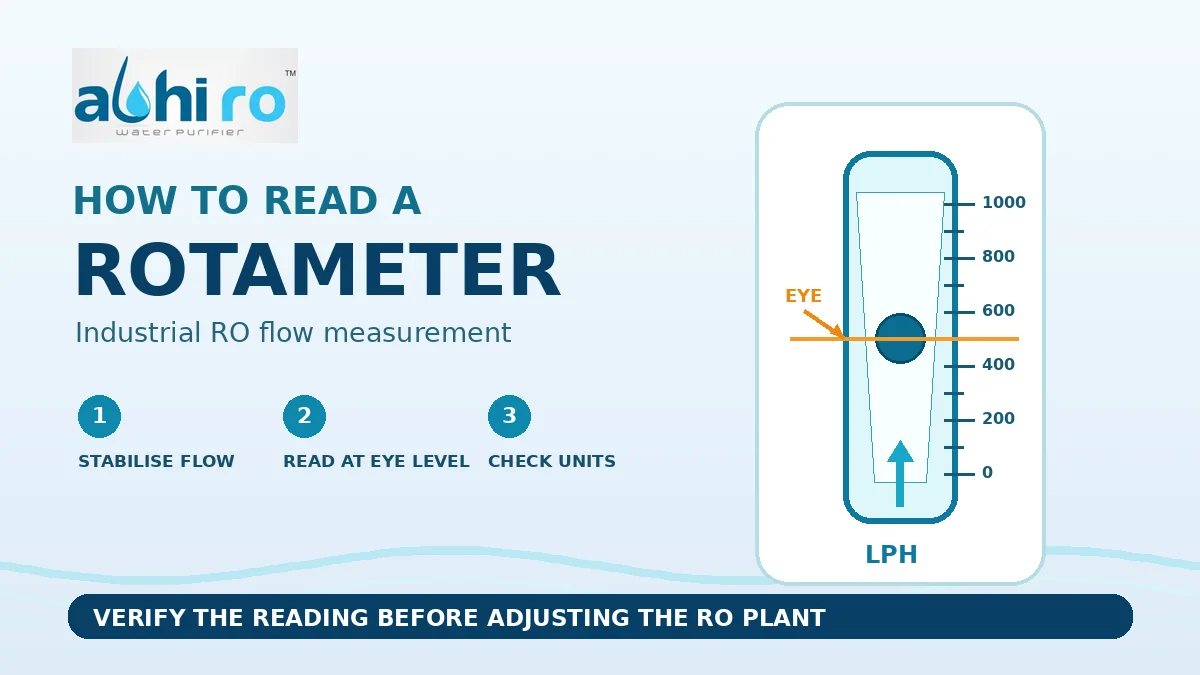
To read a rotameter correctly, allow the RO plant to stabilise, view the float at eye level and use the reference point specified for that float shape. Confirm the scale units and service fluid before recording the value. A tilted meter, trapped air, a dirty tube or a sticking float can create a misleading reading and should be corrected before adjusting the plant.
What You Will Learn
- How a rotameter measures flow
- How to read the scale correctly
- Which RO flow points to monitor
- Why the float sticks, bounces or reads zero
- How to verify a doubtful reading
- How to select a replacement rotameter
- Frequently asked questions
How a Rotameter Measures Water Flow
A rotameter is a variable-area flow meter in which water normally moves upward through a tapered tube and lifts a float. The float settles where the hydraulic lifting force and buoyancy balance its effective weight. Its position against the scale indicates flow, usually in litres per hour (LPH), litres per minute (LPM) or cubic metres per hour (m³/h).
The scale is valid only for the meter’s intended fluid and operating basis. Do not assume that two tubes with similar dimensions have the same range or calibration. Tube taper, float material and shape, liquid properties and calibration conditions all matter. ABHIRO’s industrial flow meter and rotameter category shows common inline, panel-mount and flanged configurations used in water-treatment plants.
How to Read a Rotameter Correctly
The most reliable reading is taken after flow is steady, with the tube vertical and the operator’s eye level with the float. Looking from above or below introduces parallax error. The correct float reference point depends on its shape, so follow the meter label or manufacturer’s manual rather than using one rule for every design.
- Run the RO plant until pressures, conductivity and flows have stabilised.
- Confirm which line the meter serves: feed, permeate, reject, recycle or another stream.
- Check the printed unit and full-scale range before noting the number.
- Stand directly in front of the tube and bring your eyes level with the float.
- Use the indicated reading edge. For many shaped floats this is the widest reference edge; for a ball float it is commonly the centre. Verify the installed model’s instructions.
- Record the value together with time, pressure, temperature and conductivity so the reading has operating context.
Do not force the float or strike the tube. A transparent flow meter can still contain pressure, and acrylic or glass components may be damaged by impact or incompatible cleaning chemicals. Isolate, depressurise and follow the manufacturer’s procedure before removing or cleaning it.
Use Feed, Permeate and Reject Readings Together
One rotameter reading rarely explains RO performance by itself. Feed, permeate and reject flows should be recorded at the same stable operating condition and checked against the expected water balance. In a steady plant, feed flow should be reasonably close to permeate plus reject flow, allowing for any recycle, sampling or measurement uncertainty.
- Feed flow shows the water entering the membrane section.
- Permeate flow shows useful product-water output.
- Reject flow shows concentrate leaving the membrane section.
- Recycle flow, where designed, must not be confused with net feed or reject flow.
Use ABHIRO’s RO recovery-rate calculation guide to interpret these readings. If flow has changed along with pressure or product conductivity, compare the complete operating record using the industrial RO troubleshooting guide.
Why a Rotameter Float Sticks, Bounces or Reads Zero
An unstable or implausible reading often comes from installation or water conditions rather than a sudden change in actual flow. Check for simple causes before moving a reject valve, changing pump speed or altering recovery.
- Float stays at zero: no flow, a closed valve, reversed flow direction, blocked line, stuck float or a range much higher than the actual flow.
- Float bounces: pulsating pump output, entrained air, cavitation, unstable control valve, rapidly changing backpressure or flow below the useful range.
- Float sticks: scale, iron, slime, debris, tube damage, a tilted installation or swollen/incompatible internal parts.
- Reading is unexpectedly high or low: wrong scale or units, incorrect meter for the fluid, bypass flow, leakage, installation stress or operation outside the calibrated range.
- Tube is cloudy: deposits, scratching, chemical attack or ageing may make visual reading unreliable even if the float moves.
For pressure-related symptoms, also inspect upstream filters, valves and pump conditions. ABHIRO’s industrial RO pressure-drop guide helps locate restrictions instead of treating the flow meter as the only possible fault.
How to Verify a Doubtful Flow Reading
A timed-volume check can provide a practical cross-check on an accessible, safely discharged permeate or reject stream. It is not suitable where the stream cannot be collected safely, where pressure is retained or where plant procedures prohibit opening the line.
- Keep the plant at a stable operating condition.
- Use a clean container with a known volume and a suitable timer.
- Collect the complete discharge for a measured interval without changing the valve position.
- Calculate flow: litres collected ÷ seconds × 3,600 = LPH.
- Repeat the test and compare the average with the rotameter reading.
- If the difference is material, inspect installation, cleanliness and meter range; arrange calibration or replacement where required.
For example, 10 litres collected in 30 seconds equals approximately 1,200 LPH. Treat this as an operating check, not a substitute for traceable calibration where the process or quality system requires it. The general reading principles for variable-area meters are also described by DwyerOmega.
How to Select a Replacement RO Rotameter
A replacement must match the actual flow range, liquid, pressure, temperature and connection—not just the old tube’s overall length. Choose a range that keeps normal flow away from the extreme bottom or top of the scale, subject to the manufacturer’s recommended operating range.
- normal, minimum and maximum flow;
- scale unit and calibration fluid;
- line pressure and water temperature;
- connection size, type and direction;
- inline, panel-mount or flanged arrangement;
- body, float and seal compatibility;
- available straight piping and vertical mounting;
- required accuracy, visibility and calibration documentation.
Share the old meter label, clear photographs, line size and measured flow range when requesting a replacement. Do not select only by plant capacity: a permeate meter and a reject meter on the same RO plant may need different ranges.
Frequently Asked Questions
Should a rotameter be installed vertically?
Most conventional rotameters require a vertical installation with upward flow, but the installed manufacturer’s instructions are authoritative. A tilted tube can change float behaviour and reading accuracy.
Do I read the top or centre of the float?
It depends on the float shape and meter design. Read at the reference point specified on the label or manual. Ball floats are commonly read at their centre, while shaped floats may use a widest or marked edge.
Can I control flow with the rotameter itself?
A rotameter indicates flow. Some models include an integral control valve, but many do not. Use only the designed valve and never restrict a line beyond the RO system or membrane supplier’s operating limits.
Why is the float at the top of the scale?
The actual flow may exceed the meter range, the float may be stuck, or the wrong meter or scale may be installed. Do not estimate above full scale; verify the line and select a suitable range.
Get Flow-Meter Selection Support in Coimbatore
ABHIRO Water Purifier supplies industrial RO systems, rotameters, pressure gauges, pumps, membranes and related water-treatment components. For selection or troubleshooting support, contact ABHIRO with the plant capacity, service line, expected flow, pressure, connection details and photographs of the existing meter.