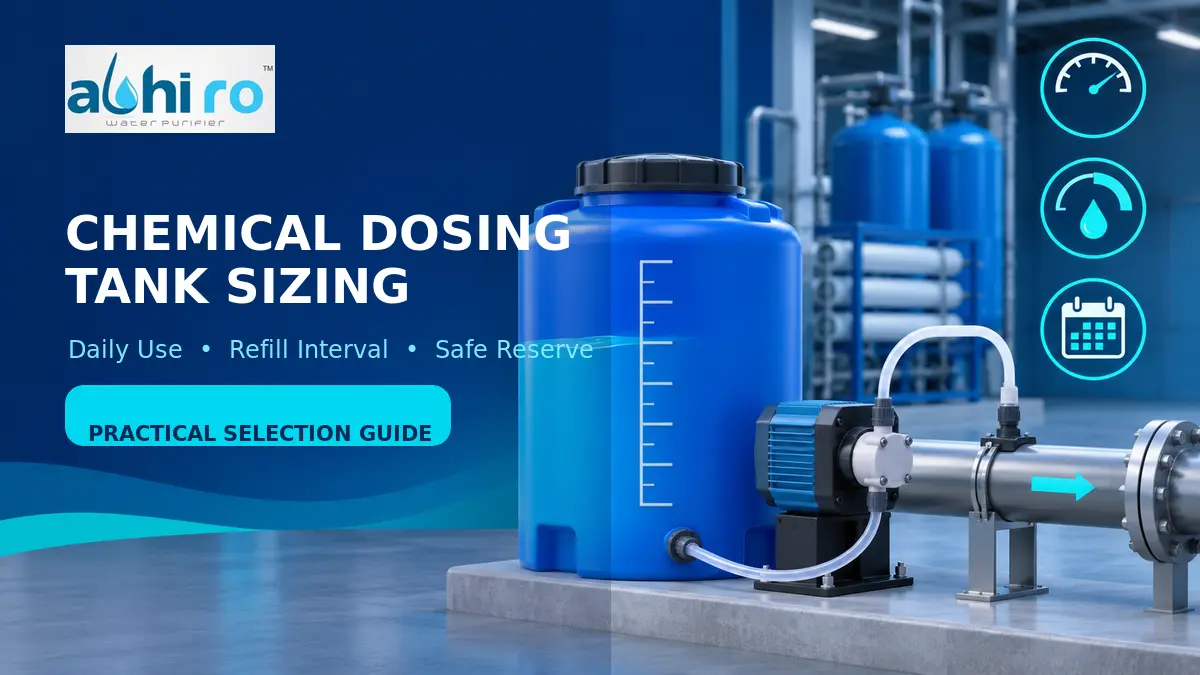
Chemical dosing tank sizing should start with the solution pump’s verified consumption, daily operating hours and desired refill interval. Multiply litres per hour by operating hours and days between refills, then allow appropriate unusable volume, mixing space and low-level reserve. Confirm chemical compatibility, bunding and safe access before selecting the final tank.
What You Will Learn
- Which inputs are required before sizing
- The dosing-tank capacity formula
- A practical calculation example
- How to select the final tank safely
- Common sizing mistakes to avoid
- Frequently asked questions
Inputs Needed for Chemical Dosing Tank Sizing
The tank cannot be sized reliably from plant flow alone. First determine how much prepared solution the dosing pump actually delivers and how long the system operates each day.
- Measured solution flow: the pump output in litres per hour at the normal injection pressure.
- Operating hours: the real daily runtime of the dosing system, not simply the plant’s design maximum.
- Refill interval: how many operating days the tank should support between preparations.
- Stock concentration: the prepared solution strength required by the approved dosing calculation.
- Usable-volume allowance: space reserved for mixing, low-level shutdown, sediment or suction limitations.
- Site conditions: chemical compatibility, temperature, ventilation, access and secondary containment.
Do not use the pump’s dial percentage as the consumption figure. Calibrate the pump under actual operating pressure. ABHIRO’s chemical dosing-pump selection guide explains the pressure, compatibility and suction-side checks that affect stable delivery.
Chemical Dosing Tank Capacity Formula
Use the prepared-solution flow—not the neat chemical consumption—in the tank calculation. The tank holds the solution that the pump draws.
Daily solution use (L/day) = Calibrated pump output (L/h) × Operating hours per day
Required usable volume (L) = Daily solution use × Days between refills
Nominal tank volume (L) = Required usable volume ÷ Selected usable-volume fraction
The usable-volume fraction is a design decision, not a universal constant. It depends on the tank geometry, mixer, suction connection, low-level switch and operating procedure. For example, treating 80% of a tank as usable means dividing the required usable volume by 0.80. Confirm the allowance for the actual installation.
Worked Dosing Tank Calculation Example
Assume a dosing pump has been calibrated to deliver 1.2 L/h of prepared solution, operates for 10 hours per day and should run for three days between refills.
- Calculate daily use: 1.2 L/h × 10 h/day = 12 L/day.
- Calculate three-day usable volume: 12 L/day × 3 days = 36 L.
- Apply the example usable fraction: 36 L ÷ 0.80 = 45 L nominal capacity.
- Select a practical tank: choose the next suitable standard size only after confirming mixer space, low-level reserve, chemical compatibility and site containment.
This example sizes the solution tank; it does not establish the correct chemical dose. For RO antiscalant, calculate the dose from feed flow, product recommendation and actual water chemistry using ABHIRO’s RO antiscalant dosing calculation guide.
How to Select the Final Tank and Accessories
Capacity is only one selection factor. The final assembly must store and feed the selected solution safely without contamination, leaks or repeated loss of pump prime.
- Confirm tank, lid, gasket, tubing and fitting compatibility with the exact chemical and concentration.
- Use a clearly labelled tank with a secure lid and an accessible filling point.
- Keep the suction line short, airtight and arranged to avoid air pockets.
- Position the foot valve or suction lance so settled material is not continuously drawn into the pump.
- Provide a low-level alarm or interlock where dry running would create a process or equipment risk.
- Assess bunding or secondary containment for the full stored volume and applicable site requirements.
- Use controlled mixing only when the solution requires it; excessive agitation may cause foaming or gas release.
Never place incompatible chemicals in a shared containment area without a chemical-risk review. Acids and hypochlorite solutions require especially careful segregation because accidental contact can release hazardous gas. Follow the chemical supplier’s safety data sheet and the site’s handling procedure.
Common Dosing Tank Sizing Mistakes
Most sizing errors come from using an assumed pump rate or ignoring how the solution is prepared and refilled.
- Sizing from the pump’s maximum rating instead of its calibrated output.
- Using neat-chemical consumption when the tank contains a diluted solution.
- Ignoring shutdown days, variable plant flow or seasonal operating hours.
- Filling to the brim without mixing space or a low-level reserve.
- Choosing a very large tank that leaves an unstable solution stored for too long.
- Changing dilution strength without recalculating the pump setting and relabelling the tank.
- Combining different chemicals in one tank without written compatibility confirmation.
Record the preparation date, chemical quantity, final solution volume, pump calibration and tank level. Comparing expected and actual consumption helps reveal air leaks, loss of prime, incorrect settings or operator errors.
Frequently Asked Questions
Should a dosing tank be sized for one day or several days?
Use the refill interval that fits the site’s staffing, solution stability and operating risk. A longer interval reduces preparation frequency but increases stored volume and may be unsuitable for solutions that degrade, settle or require frequent verification.
Can the dosing pump’s rated LPH be used directly?
No. Measure the actual output at the normal injection pressure. Pump delivery can differ with pressure, stroke setting, tubing condition, air entry and chemical properties.
Is a bigger chemical tank always better?
No. Oversizing increases chemical inventory and can extend solution storage beyond an appropriate period. Select enough usable volume for the planned refill interval plus justified operating allowance.
Does every dosing tank require a mixer?
No. Mixing depends on the chemical, dilution procedure and solution behaviour. Follow the chemical supplier’s preparation instructions and avoid excessive agitation when it could cause foaming, gas release or degradation.
Plan a Chemical Dosing System With ABHIRO
ABHIRO Water Purifier supplies chemical dosing pumps and water-treatment components for industrial RO, filtration and process-water systems in Coimbatore and across India. Share the chemical name, concentration, required dose, plant flow, operating hours, injection pressure, refill interval and site photographs. Browse the dosing-pump category, review the broader industrial water-treatment range, or contact ABHIRO for application-based selection support.