
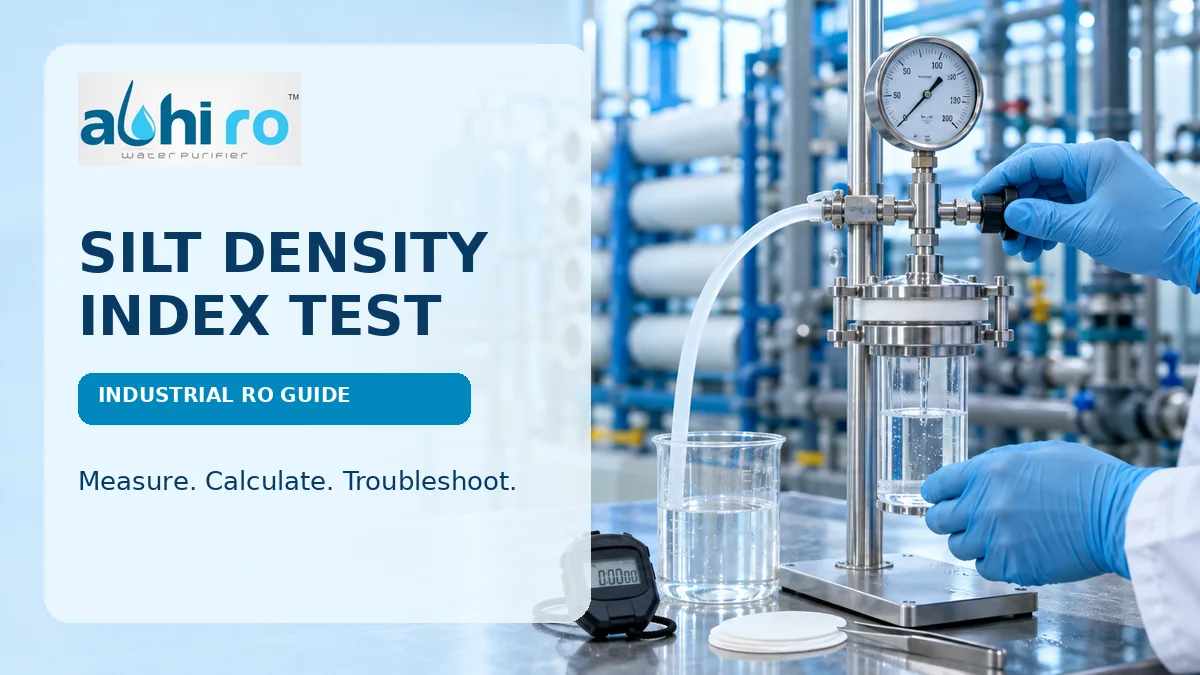
A silt density index test for RO measures how quickly suspended and colloidal matter plugs a 0.45-micrometre filter under controlled pressure. The result helps operators track particulate-fouling potential before the RO membranes. SDI should be interpreted as a trend alongside turbidity, filter pressure drop and cartridge life—not used as a complete water analysis or a stand-alone membrane guarantee.
What You Will Learn
- What an SDI test measures
- Equipment needed for an SDI15 test
- How to perform the test step by step
- How to calculate SDI15
- How to interpret and troubleshoot the result
- Common testing mistakes
- Frequently asked questions
What Does the Silt Density Index Measure?
SDI indicates the rate at which matter in the sample blocks a standard membrane filter. It is commonly measured at the RO feed after pretreatment, where it can reveal changes that may not be obvious from a single turbidity reading. It does not identify the particles, predict scaling chemistry or measure dissolved salts.
This distinction matters in industrial plants. A feed sample can have acceptable conductivity yet still carry fine colloids capable of fouling an RO element. Conversely, an elevated SDI does not prove that the RO membrane is already fouled; it tells the operator to examine the pretreatment system and the feed-water condition.
Equipment Needed for an SDI15 Test
Consistent equipment and sampling conditions are essential because small procedural differences can change the result. Prepare the following items before opening the test point:
- An SDI test assembly with pressure regulator and gauge
- A clean 47 mm membrane filter with a nominal 0.45 µm pore size
- Clean forceps for handling the membrane
- A graduated 500 mL container
- A stopwatch or accurate timer
- Clean tubing and a representative RO-feed sampling point
- A log sheet for pressure, temperature, sample point and timings
Use the same type of membrane and the same sampling location for routine trend checks. If a site changes either, note it clearly in the operating log. For broader monitoring, see ABHIRO’s industrial RO water-testing checklist.
How to Perform an SDI15 Test Step by Step
The usual SDI15 procedure uses a constant test pressure of 30 psi (approximately 2.1 bar) and compares the time needed to collect 500 mL at the start and after 15 minutes. Follow the current method specified by the system designer, membrane supplier or applicable laboratory procedure.
- Select the sample point. Test the water at a clearly identified location, normally after pretreatment and before the RO membrane. Keep chemical-dosing conditions stable.
- Flush the line. Allow stagnant water and loose debris to clear. Flush the test apparatus without the membrane until trapped air is removed.
- Install the membrane. Use clean forceps and avoid touching the active filter area. Seat the membrane flat in the holder.
- Set the pressure. Bring the pressure to 30 psi and keep it stable throughout the test. Record the actual pressure.
- Measure the initial collection time. Start the stopwatch as collection begins and record the seconds required to collect 500 mL. This is ti.
- Continue filtration. Allow water to flow through the same membrane while maintaining the test pressure.
- Measure the final collection time. At the selected interval—commonly 15 minutes—record the seconds required to collect another 500 mL. This is tf.
- Calculate and log the result. Record the sample point, date, pressure, water temperature, filter details and any unusual observation.
How to Calculate SDI15
The calculation expresses the average percentage plugging rate per minute over the test period:
SDIT = [1 − (ti ÷ tf)] × 100 ÷ T
- ti = initial time to collect 500 mL
- tf = final time to collect 500 mL
- T = elapsed test duration in minutes
Example: if the initial collection takes 30 seconds and the 15-minute collection takes 45 seconds, SDI15 = [1 − (30 ÷ 45)] × 100 ÷ 15 = 2.22. Report the result with the interval as SDI15 = 2.22. Do not round the timing inputs too aggressively.
How to Interpret the SDI Result
The most useful interpretation is comparison with the RO system’s documented feed-water requirement and with the plant’s own baseline. Do not apply one universal pass/fail value to every membrane, recovery, feed source or pretreatment design.
If SDI rises above its normal trend, investigate systematically:
- Repeat the test after confirming pressure, flushing and membrane handling.
- Compare raw-water and post-pretreatment turbidity.
- Review pressure loss and backwash history across media filters.
- Inspect cartridge-filter condition, micron selection and sealing.
- Check coagulation or chemical dosing where these processes are used.
- Look for source-water changes after rainfall, tank cleaning or supply switching.
- Compare membrane pressure drop, normalized permeate flow and cleaning history.
ABHIRO’s industrial RO systems, filter housings and industrial RO membranes can be reviewed when planning or troubleshooting a pretreatment train in Coimbatore or elsewhere in India.
Common SDI Testing Mistakes
Most unreliable SDI results come from inconsistent technique rather than difficult mathematics. Avoid these errors:
- Testing from an unflushed or non-representative line
- Allowing pressure to drift during the measurement
- Touching, creasing or incorrectly seating the membrane
- Leaving air trapped in the holder or tubing
- Changing the membrane type between trend readings
- Recording SDI without the test interval
- Comparing results taken at different process locations
- Treating SDI as a replacement for complete water analysis
Frequently Asked Questions
Where should an SDI sample be collected?
For membrane-protection monitoring, collect a representative sample after the complete pretreatment process and before the RO membrane. Additional upstream tests can help locate the stage where particulate removal is underperforming.
Is low turbidity proof that SDI will also be low?
No. Turbidity and SDI describe different aspects of water quality. Both can support troubleshooting, but one should not be used as a direct substitute for the other.
How often should an industrial RO plant measure SDI?
Frequency depends on source-water variability, plant criticality and operating history. Test more often during commissioning, seasonal source changes or unexplained cartridge and membrane fouling, then establish a site-specific routine.
Can SDI identify what type of foulant is present?
No. SDI indicates plugging behaviour but does not identify whether the material is clay, corrosion debris, biological matter or another foulant. Filter inspection and suitable laboratory analysis may be required.
Improve RO Pretreatment with Better Operating Data
If your industrial RO plant in Coimbatore is experiencing short cartridge life, rising membrane pressure drop or declining output, share the water analysis, SDI trend and operating readings with ABHIRO. We can help review the pretreatment arrangement and identify suitable components without relying on guesswork. Contact ABHIRO Water Purifier for system and spare-selection support.
Explore more practical guides in the ABHIRO Water Treatment Knowledge Centre, covering industrial RO systems, membranes, water testing, maintenance, treatment chemicals and water-treatment components.