Industrial RO high-pressure pump selection starts with two design values: the feed flow required by the membrane array and the pressure needed at that flow. The correct pump must meet this duty point while maintaining adequate suction conditions, compatible wetted materials and a suitable motor. Selecting only by plant LPH or motor horsepower can produce unstable performance and unnecessary energy use.
What You Will Learn
- How to define the pump duty point
- How to estimate required feed flow
- What determines operating pressure
- How to read a pump curve
- Why suction conditions and NPSH matter
- How to check materials, motor and controls
- A practical selection checklist
- Frequently asked questions
Define the RO Pump Duty Point Before Comparing Models
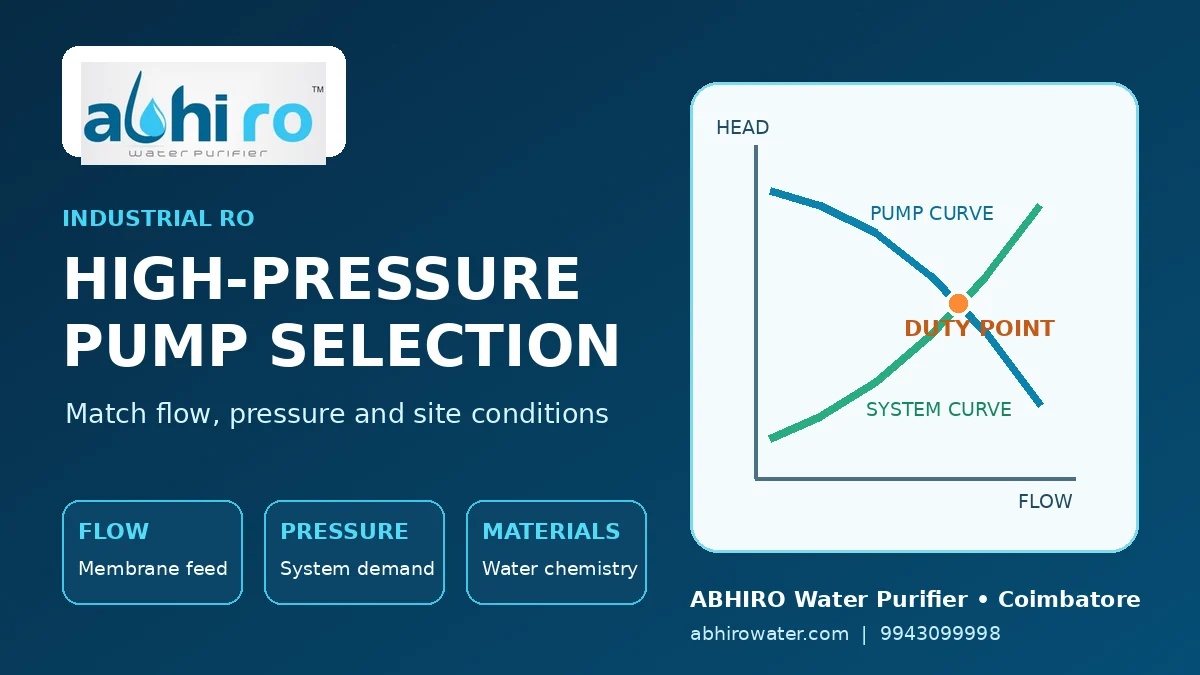
The duty point is the combination of flow and total pressure or head that the pump must deliver during normal operation. It should come from the RO system design, membrane projection and piping calculation—not from a general horsepower table.
Give the pump supplier a clear operating envelope rather than one isolated number. Include normal flow, minimum and maximum expected flow, required discharge pressure, suction pressure, feed-water temperature and the pressure losses between the pump and membrane vessels. For an existing plant, record stable readings before replacing the pump.
Calculate the Feed Flow the Pump Must Deliver
Pump flow must cover the membrane feed requirement, not just the permeate production rate printed on the plant. Feed flow is higher than product-water flow because part of the water leaves as concentrate.
A useful design relationship is:
Feed flow = Permeate flow ÷ Design recovery
For example, a 2,000 LPH plant designed for 60% recovery requires approximately 3,333 LPH of feed flow before considering any designed recycle stream or other system-specific allowance. Recovery must come from the membrane design and water analysis; it should not be increased simply to reduce the pump size.
ABHIRO’s industrial RO recovery-rate guide explains how to calculate and verify recovery using measured feed, permeate and reject flows.
Estimate Required Pressure from the Complete RO System
The selected discharge pressure must overcome the membrane feed-pressure requirement plus losses through cartridge filters, valves, piping, fittings and elevation. Feed salinity, temperature, membrane type, recovery and fouling allowance all influence the final value.
- Use the membrane projection or system designer’s specified feed pressure.
- Add realistic losses from the pump discharge to the membrane inlet.
- Allow only the design margin justified by operating uncertainty.
- Do not compensate for blocked filters or undersized piping by permanently oversizing the pump.
If an existing plant shows rising pressure loss, diagnose the restriction first. The ABHIRO industrial RO pressure-drop guide helps separate pretreatment, valve, piping and membrane-stage problems.
Read the Pump Curve at the Required Operating Point
The chosen pump curve should pass through the required duty point at the intended speed and impeller configuration. A nameplate maximum flow or maximum head does not show that the pump can supply both values simultaneously.
- Head-flow curve: confirms the pressure available at the required flow.
- Efficiency curve: shows whether the duty point is reasonably close to the efficient operating region.
- Power curve: helps confirm that the selected motor will not be overloaded across the expected range.
- NPSH required curve: supports the suction-side check and cavitation assessment.
The Hydraulic Institute describes the best efficiency point as the flow and head where pump efficiency is highest for a given speed and impeller diameter. It also provides pump-curve and system-curve resources in its Data Tool. Final selection should still follow the specific pump manufacturer’s published curve and limits.
Check Suction Conditions and NPSH Margin
A pump that meets the discharge duty can still cavitate if the inlet pressure is inadequate. Verify that net positive suction head available exceeds the pump’s required value with a suitable engineering margin under the worst expected operating condition.
- Keep suction piping short, adequately sized and free from unnecessary restrictions.
- Check minimum tank level, elevation difference and suction-filter pressure loss.
- Consider the highest expected water temperature because vapour pressure changes.
- Prevent air entry through loose joints, vortexing or an intermittently empty feed line.
Typical warning signs include crackling noise, vibration, unstable discharge pressure and reduced flow. Stop and investigate rather than throttling the suction line.
Match Wetted Materials, Motor and Controls
Pump materials must be compatible with the actual feed-water chemistry and cleaning exposure. Chlorides, pH, temperature and any dosed chemicals should be reviewed before selecting casing, impeller, shaft and seal materials.
Also confirm electrical supply, motor efficiency, enclosure, starting method and overload protection. A variable-frequency drive can help commission and control flow where the pump and motor are suitable, but it must not be used to exceed the pump curve, motor rating, membrane limits or minimum-flow requirement.
Browse ABHIRO’s industrial RO high-pressure pump category and industrial RO system range when planning a new installation or replacement.
Industrial RO High-Pressure Pump Selection Checklist
A complete selection request reduces the risk of receiving a pump that fits the pipe but misses the operating duty. Collect the following information before requesting a quotation.
- Record required permeate capacity and design recovery.
- Calculate or confirm normal, minimum and maximum feed flow.
- Provide membrane model, quantity and array configuration.
- State required membrane-inlet pressure and calculated piping losses.
- Provide suction-tank level, suction pressure, pipe size and temperature range.
- Share feed-water analysis and chemicals present upstream of the pump.
- Confirm voltage, phase, frequency, control method and available motor protection.
- Request the manufacturer’s pump curve and verify the complete duty point.
Frequently Asked Questions
Can I select an RO pump only from plant capacity in LPH?
No. Plant LPH normally refers to permeate production. Pump selection also needs feed flow, required pressure, recovery, suction conditions, water chemistry and the pump curve.
Is a larger motor always safer for an industrial RO pump?
No. The hydraulic duty, pump curve and absorbed power determine the suitable motor. Unnecessary oversizing can increase cost and may encourage operation away from the intended duty point.
Can a VFD correct an oversized pump?
A VFD can adjust speed within approved limits, but it does not correct every selection or system-design problem. Verify minimum speed, cooling, motor suitability, pump curve and membrane operating range.
What information should I send for a replacement pump?
Send the existing nameplate, pump curve if available, suction and discharge pressures, measured flow, membrane details, water analysis, pipe sizes, electrical supply and photographs of the installation.
Get Pump-Selection Support from ABHIRO in Coimbatore
ABHIRO Water Purifier supplies high-pressure pumps, industrial RO systems, membranes, instruments and related spares for dealers, OEMs and water-treatment projects. For a practical selection review, contact ABHIRO with your water report, membrane configuration, required flow, pressure readings and electrical details.
Explore more practical guides in the ABHIRO Water Treatment Knowledge Centre, covering industrial RO systems, membranes, water testing, maintenance, treatment chemicals and water-treatment components.