
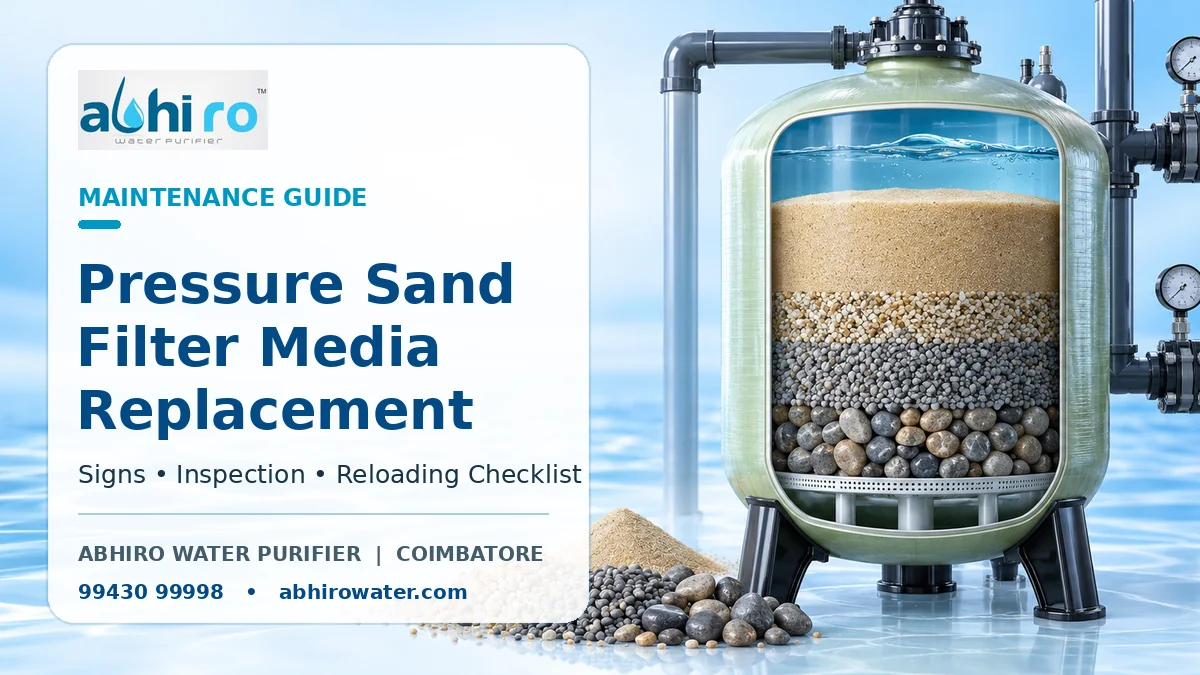
Pressure sand filter media should be replaced only after operating data and an internal inspection show that cleaning or correcting the backwash system will not restore performance. Rising differential pressure, shorter filter runs, persistent outlet turbidity, channelled or cemented media, and media loss are useful warning signs—but each can also result from valves, pumps, distributors or incorrect operating flow.
What You Will Learn
- What the filter media does
- Signs that require investigation
- Checks to make before replacement
- How to inspect the media bed
- A practical replacement checklist
- How to prevent early media problems
- Frequently asked questions
What Pressure Sand Filter Media Actually Does
A pressure sand filter reduces suspended particles and turbidity by passing water through a correctly selected and arranged granular bed. It does not remove dissolved salts, and it should not be judged using TDS alone. Its performance depends on raw-water loading, media grading and depth, service velocity, distribution, backwash flow and the condition of the vessel and valve.
Many filters use filtration sand above graded support media or gravel. The exact material, particle size and loading arrangement must follow the approved design. Copying the media quantity or layer order from another vessel can produce excessive pressure loss, carryover, poor distribution or inadequate cleaning.
For system-level selection, see ABHIRO’s FRP vessel guide and FRP pressure-vessel range.
Warning Signs That Need Investigation
The strongest replacement decision comes from several observations together, not from the age of the media alone. Record inlet and outlet readings at comparable flow and valve position, then look for a trend.
- Persistent outlet turbidity: quality remains poor even after a correctly performed backwash and rinse.
- Shorter filter runs: differential pressure rises much faster than it did after commissioning.
- High clean-bed pressure drop: resistance remains abnormal immediately after backwashing.
- Media at the drain or outlet: the bed may be escaping because of excessive backwash, damaged internals or unsuitable grading.
- Channeling or hard clumps: water bypasses parts of a bed that has become compacted, cemented or biologically fouled.
- Reduced bed depth: repeated media loss leaves insufficient filtration depth.
ABHIRO’s industrial RO pressure-drop guide explains how to compare pressure readings without confusing a flow change with a blockage.
Checks to Make Before Replacing the Media
Before opening the vessel, eliminate faults that can make healthy media appear exhausted. A weak backwash, partially closed valve or faulty gauge can create the same symptoms as a dirty bed.
- Verify the instruments. Check gauge condition and compare inlet and outlet pressure at the normal service flow.
- Review the operating log. Compare differential pressure, flow and outlet turbidity with the clean commissioned baseline.
- Confirm valve operation. Make sure the valve reaches the intended service, backwash and rinse paths without internal leakage or a blocked drain.
- Check available backwash flow. Inspect pump output, line restrictions and drain capacity against the system design.
- Perform a controlled backwash and rinse. Follow the valve and media instructions, then retest at the same service flow.
- Review raw-water changes. Seasonal turbidity, iron, organics or upstream chemical changes can sharply increase loading.
For a safe manual sequence, refer to ABHIRO’s multiport-valve operation guide. Never rotate a manual valve while the pump is running or the filter remains pressurised.
How to Inspect the Filter Bed
An internal inspection can confirm whether the bed is level, correctly graded and free from hardened deposits. Isolate, drain and depressurise the system according to the approved site procedure before opening it. Confined-space and chemical hazards must be assessed by competent personnel.
- Measure the remaining bed depth instead of estimating it visually.
- Look for cracks, channels, mud balls, clumping, slime or cemented zones.
- Check whether fine media has mixed into the support layers.
- Inspect the distributor, laterals, strainers and central pipe for damage.
- Collect representative samples from more than one depth when laboratory examination is justified.
If the media is intact and the real problem is inadequate backwashing, replacing it without correcting the hydraulic cause will allow the same failure to return.
Pressure Sand Filter Media Replacement Checklist
Replacement should restore the approved layer arrangement and preserve the vessel internals. Record the existing system before unloading so that connections and components can be checked during reassembly.
- Lock out the pump, isolate the vessel, drain it and verify zero pressure.
- Photograph connections and protect the distributor opening from falling media.
- Remove old media using a method suitable for the vessel and site; do not damage the liner or internals.
- Inspect and replace damaged distributors, strainers, seals or valve components before reloading.
- Confirm the specified media type, grading, quantity, layer sequence and required freeboard.
- Load support media carefully and keep each layer even; follow the vessel and media supplier’s procedure.
- Backwash gently at first to remove fines, then increase only to the approved rate.
- Rinse to drain until water is acceptably clear, then return to service and verify flow, pressure drop and outlet quality.
- Record the new clean-bed baseline for future comparisons.
How to Prevent Early Media Problems
Consistent monitoring and adequate backwashing protect the bed better than a fixed replacement calendar. Install usable sampling points and pressure gauges, and train operators to record readings under comparable conditions.
- Track inlet and outlet turbidity where it is a relevant control parameter.
- Record service flow and differential pressure rather than pressure alone.
- Investigate unusual backwash water, media carryover or rapid pressure recovery.
- Keep the drain line unobstructed and verify the backwash pump periodically.
- Review pretreatment after any major change in water source or production demand.
Frequently Asked Questions
How often should pressure sand filter media be replaced?
There is no reliable universal interval. Source-water loading, media selection, service velocity, backwashing and chemical or biological fouling all affect useful life. Use performance trends and inspection findings rather than age alone.
Does high pressure drop always mean the sand is exhausted?
No. A loaded bed is one possible cause, but blocked piping, incorrect valve position, gauge error and excessive flow can also increase differential pressure.
Can only the lost top layer be refilled?
Only after checking why media was lost and confirming the condition, grading and layer integrity of the remaining bed. Topping up without repairing damaged internals or correcting excessive backwash may repeat the problem.
Can pressure sand filter media reduce TDS?
No. A conventional pressure sand filter mainly addresses suspended particles and turbidity. Dissolved salts require a treatment process selected from water analysis and the intended use.
Plan the Replacement With ABHIRO
For pressure-filter media, FRP vessels, multiport valves and RO pretreatment components, contact ABHIRO Water Purifier, Coimbatore. Share the vessel model and opening, existing media arrangement, service and backwash flow, inlet and outlet readings, raw-water report and clear photographs. These details help distinguish a media problem from a hydraulic or component fault before material is ordered.
