Industrial RO solenoid valve troubleshooting should begin by identifying whether the fault is electrical, hydraulic or mechanical. Isolate the plant safely, confirm the specified coil voltage, check whether pressure and flow direction suit the valve, and inspect for debris or seal damage. Never energise a removed coil or dismantle a pressurised valve without the manufacturer’s procedure.
What You Will Learn
- How an RO solenoid valve works
- Safety checks before testing
- What to check when the valve will not open
- What to check when the valve will not close
- Why a valve chatters or overheats
- How to select a compatible replacement
- Frequently asked questions
How a Solenoid Valve Controls an Industrial RO Plant
A solenoid valve uses an electromagnetic coil to move a plunger or pilot mechanism and control water flow. In an industrial RO plant, it may isolate feed water, automate flushing, control a chemical or utility line, or work with a panel and level controller. The correct function depends on whether the valve is normally closed or normally open and whether it is direct-acting, pilot-operated or assisted-lift.
Do not assume that an energised coil guarantees flow. Many pilot-operated valves need a minimum pressure differential to open or close correctly. Flow direction, upstream pressure, downstream backpressure and the condition of the diaphragm or pilot passage all affect operation.
Complete These Safety Checks Before Troubleshooting
Electrical and hydraulic isolation must come before dismantling. A water-treatment line can retain pressure after the pump stops, while a control panel may restart equipment automatically.
- Stop the plant using the approved shutdown sequence and prevent automatic restart.
- Isolate electrical power and follow the site’s lockout procedure.
- Close the required valves and release trapped pressure through the approved drain or vent.
- Confirm zero pressure with a working gauge before loosening fittings or the valve body.
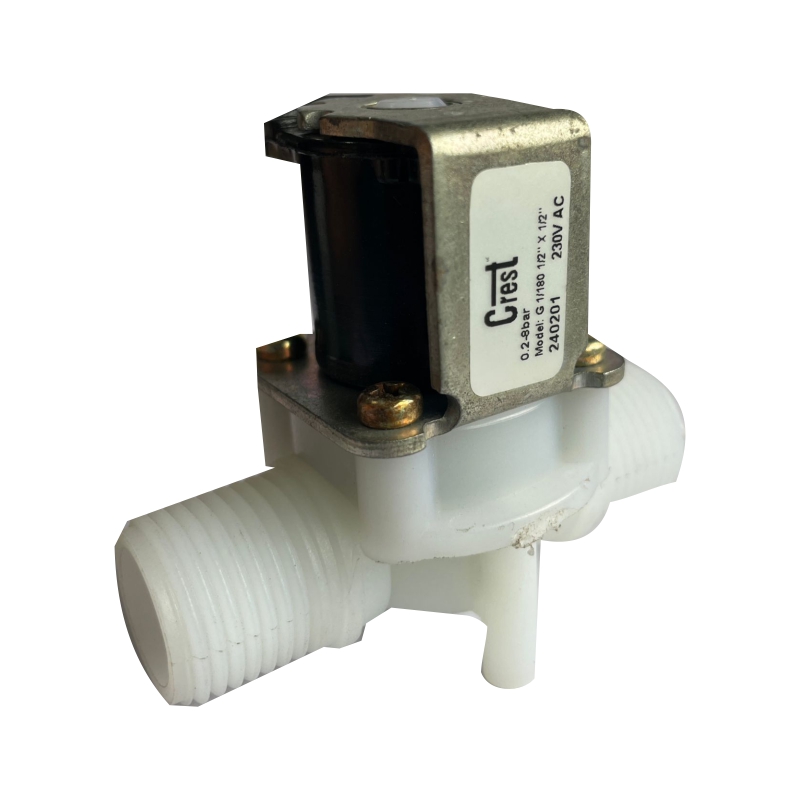
- Identify the valve model, coil voltage, current type, port size, flow arrow and normal position.
- Use a qualified electrician for live-voltage measurements and follow the manufacturer’s test instructions.
When the RO Solenoid Valve Will Not Open
A valve that stays closed can be caused by missing voltage, the wrong coil, a burnt winding, insufficient pressure differential, reversed installation or a blocked pilot passage. Check the control signal and hydraulic conditions before replacing the entire valve.
- No control output: verify the panel command, relay, fuse, terminal connection and any level or pressure interlock.
- Incorrect coil supply: compare measured voltage and AC/DC type with the coil nameplate; do not guess from wire colour.
- Open or shorted coil: isolate the coil and test it only according to the manufacturer’s resistance or continuity guidance.
- Low differential pressure: a pilot-operated valve may not open when inlet pressure or pressure drop is below its requirement.
- Reversed flow: confirm that the body arrow matches the actual water direction.
- Blocked pilot or plunger: silt, scale, rust or seal fragments can restrict the small internal passages.
If the control panel is commanding the valve correctly but upstream pressure is also low, diagnose the wider system rather than treating the valve alone. ABHIRO’s industrial RO pressure-drop guide helps locate restrictions across filters, piping and membrane stages.
When the Valve Will Not Close or Keeps Passing Water
Internal leakage after de-energising usually points to trapped debris, a damaged seat or diaphragm, an incorrect pressure condition, reverse pressure or a valve that is unsuitable for the duty. Confirm that the coil is genuinely de-energised before opening the body.
- Check for residual or induced voltage at the coil circuit.
- Verify the valve’s normal position; a normally open valve behaves differently when power is removed.
- Inspect the plunger, seat, diaphragm and pilot hole for dirt or damage.
- Confirm downstream pressure is not forcing reverse flow through an unsuitable design.
- Look for swollen or hardened elastomers caused by chemical or temperature incompatibility.
- Check whether water hammer or repeated fast cycling has damaged internal parts.
Cleaning may restore a valve affected by loose debris, but scratched seats, torn diaphragms, distorted plungers or degraded seals require compatible service parts or valve replacement. Do not grind, drill or modify internal components to make the valve operate.
Why a Solenoid Valve Chatters, Hums or Overheats
Chattering commonly indicates unstable voltage, poor coil seating, fluctuating pressure, rapid control switching or contamination that prevents full plunger travel. A coil may run warm in normal service, but unusual heat, odour, discoloration or repeated failure requires shutdown and diagnosis.
- Measure supply voltage at the valve while it is commanded on.
- Check the controller for rapid on-off cycling from a faulty level switch or unstable signal.
- Confirm the coil is fully seated on the correct armature tube.
- Inspect for loose terminals, moisture entry and damaged cable insulation.
- Verify the ambient and fluid temperatures remain within the valve specification.
- Investigate pump surges and water hammer instead of fitting repeated replacement coils.
Select a Compatible Replacement Solenoid Valve
A replacement should match the application, not only the pipe size. Record the existing valve and system conditions before ordering from ABHIRO or another supplier.
- normal position: normally closed or normally open;
- coil voltage, frequency and AC/DC supply;
- port size, thread or flange type and flow direction;
- maximum and minimum operating pressure differential;
- body, diaphragm and seal compatibility with the water or chemical;
- fluid and ambient temperature range;
- required flow and acceptable pressure loss;
- electrical enclosure and environmental protection needed at the site.
ABHIRO supplies industrial and RO solenoid valves in Coimbatore and industrial RO control panels. Explore the wider industrial water-treatment range or visit the ABHIRO Water Treatment Knowledge Centre for related operating guides.
Frequently Asked Questions
Can I test a solenoid coil by energising it after removing it?
Do not energise a removed coil unless the manufacturer explicitly provides a safe test method. Some coils can overheat or fail when energised without the correct armature assembly.
Why does the coil click but no water flows?
The coil may be moving the plunger while flow remains blocked by low inlet pressure, insufficient differential pressure, reversed installation, a closed upstream valve or debris in the pilot passage.
Can one solenoid valve be used for feed water and chemicals?
Not automatically. Body and seal materials must be compatible with the specific fluid, concentration and temperature. Confirm the manufacturer’s compatibility guidance before selection.
Should I replace only the coil or the complete valve?
A confirmed electrical coil failure may require only the correct replacement coil. A damaged seat, diaphragm, body, armature tube or incompatible valve specification may justify replacing or rebuilding the complete valve.
Get Solenoid-Valve Selection Support from ABHIRO
For a useful recommendation, share the valve photograph, model, port size, coil label, normal position, line pressure, fluid, operating temperature and control-panel details. ABHIRO Water Purifier supports industrial RO operators, plant builders and service technicians from Coimbatore and across India. Call +91 99430 99998 or visit abhirowater.com.