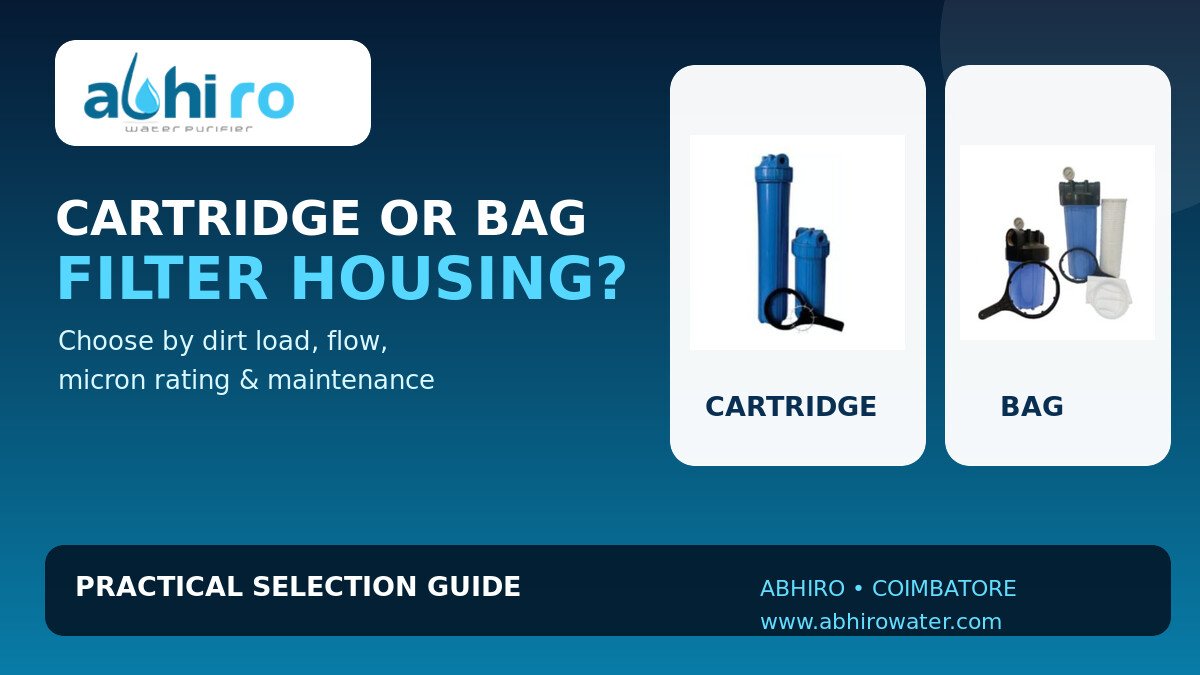
Mechanical filtration protects pumps, valves, membranes and other downstream equipment from suspended particles. Two common choices are cartridge filters and bag filters. Both place a replaceable filter element inside a pressure housing, but they differ in dirt-holding capacity, flow behaviour, maintenance and suitable applications.
Choosing between them should not be based only on purchase price or connection size. For industrial users and water-treatment professionals in Coimbatore and across India, the correct choice depends on raw-water quality, required flow, target particle removal and operating routine. This guide explains the practical differences in a cartridge vs bag filter housing comparison.
How Cartridge Filter Housings Work
A cartridge housing holds one or more cylindrical filter cartridges. Water passes through the cartridge media, and particles are retained according to the element’s design and micron rating. Common cartridge types include spun polypropylene, string-wound and pleated elements.
Cartridge filters are widely used as polishing filters and as the final particulate barrier before an RO membrane. They can provide a relatively fine and predictable filtration stage when the correct element, housing and operating conditions are selected.
ABHIRO supplies industrial filter housings and compatible options for different water-treatment duties.
How Bag Filter Housings Work
A bag filter housing supports a fabric or mesh filter bag inside a basket. Water flows through the bag, leaving suspended solids within the filter material. The larger surface and internal volume of many bag arrangements can handle heavier particle loads than a small single cartridge.
Bag filters are often considered for higher-flow prefiltration, cooling-water side streams, process water and applications where operators need to remove a significant quantity of coarse or medium-sized solids. Actual performance depends on bag material, size, micron rating and seal arrangement.
Cartridge vs Bag Filter Housing: Key Differences
1. Dirt load
Cartridges are effective where the incoming water is already reasonably clear or where fine polishing is required. When the feed contains a high suspended-solids load, a cartridge may block quickly and require frequent replacement.
A bag filter generally provides more space to collect debris and may be more practical for heavier dirt loading. However, a severe solids problem should first be investigated; an upstream settling, media-filtration or clarification stage may be more economical than repeatedly replacing disposable elements.
2. Required flow
The housing must pass the design flow without excessive pressure loss. A single small cartridge housing may suit a low-flow line, while multiple-cartridge housings can serve larger duties. Bag housings are also available in single- and multi-bag arrangements for higher flows.
Do not select from a nominal flow figure alone. Fluid viscosity, micron rating, element condition, connection size and acceptable pressure drop all influence real capacity. Request the supplier’s performance information for the chosen element and housing combination.
3. Filtration fineness
Both cartridges and bags are offered in different micron ratings, but micron numbers are not always directly comparable. A nominal rating describes an approximate removal efficiency, whereas an absolute rating is linked to a defined removal performance. The exact definition depends on the manufacturer and test method.
For membrane pretreatment or another sensitive process, confirm whether the specification requires a nominal or absolute rating. A smaller micron number does not automatically mean a better system if it causes rapid blockage or insufficient flow.
4. Maintenance routine
Cartridge replacement can be straightforward, especially in a single-element housing. Multi-cartridge housings require operators to seat every element and seal correctly. Bag filters can be quick to service, but a loaded bag may be heavy, wet and difficult to handle.
Consider safe isolation, draining, lid clearance, lifting space and access around the housing. Operators should never open a pressurised housing. Follow the manufacturer’s depressurisation and servicing instructions.
5. Operating cost
Compare the complete operating cost rather than only the housing price. Include replacement elements, labour, downtime, disposal, cleaning, pressure loss and the effect on downstream equipment. A lower-cost element that blocks frequently may cost more over a year than a properly sized alternative.
Match the Housing Material to the Application
Housing construction may include reinforced plastic, polypropylene or stainless steel, depending on the product and duty. Check compatibility with the water, cleaning chemicals, temperature and pressure. Food, pharmaceutical or corrosive-process applications may have additional material, surface-finish and documentation requirements.
Also verify the closure design, seal material, inlet and outlet size, drain and vent provisions, and element dimensions. Never assume that cartridges or bags from different systems are interchangeable simply because their stated size is similar.
Use Differential Pressure to Plan Maintenance
Install pressure gauges before and after the filter. The difference between these readings indicates how resistance changes as the element collects particles. Record the clean-filter differential pressure at commissioning and monitor its trend under comparable flow conditions.
A rising differential pressure usually indicates loading or blockage. A sudden drop can indicate bypass, element damage or a change in flow. Replace or clean the element at the limit recommended by the housing and element manufacturer—before flow to the RO or process equipment is affected.
When a Cartridge Filter Is Usually Preferred
A cartridge system is often suitable when:
- fine polishing is required;
- the suspended-solids load is low to moderate;
- the filter protects an RO or UF stage;
- compact installation is important; or
- a specific cartridge media is needed.
Explore ABHIRO’s industrial micron filter range when matching an element to a housing.
When a Bag Filter Is Usually Preferred
A bag system may be suitable when:
- the water carries a heavier particulate load;
- relatively high flow is required;
- coarse or intermediate prefiltration is the objective;
- operators need a larger debris-collection volume; or
- the process allows convenient bag removal and disposal.
These are general guidelines, not fixed rules. Water testing and site conditions should guide the final design.
Selection Checklist Before Requesting a Quote
Provide the supplier with:
- normal and maximum flow;
- inlet pressure and expected pressure variation;
- water source and suspended-solids or turbidity data;
- required micron rating and whether it must be nominal or absolute;
- water temperature and chemical exposure;
- preferred housing and seal materials;
- available installation space and connection type; and
- expected operating hours and maintenance frequency.
This information helps size the housing, element quantity and connection correctly.
Frequently Asked Questions
Can a bag filter replace a cartridge filter before an RO membrane?
Not automatically. The RO design may require a particular particle-removal rating and element performance. A bag filter can serve as upstream prefiltration, but the final arrangement should meet the membrane-system and designer’s pretreatment requirements.
Does a lower micron rating always improve water quality?
It captures smaller particles only when the element performs as specified. It may also increase pressure loss and replacement frequency. Select the rating from the process requirement and feed-water condition.
How often should filter elements be changed?
There is no universal interval. Use differential-pressure trends, outlet-water condition, operating hours and the manufacturer’s limit. A calendar-only schedule may replace clean elements too early or leave blocked elements in service too long.
Can a used filter element be washed and reused?
Only if the element manufacturer identifies it as cleanable and provides a suitable procedure. Disposable cartridges and bags should not be reused without approval, especially for hygiene-sensitive applications.
Get Filter-Housing Selection Support in Coimbatore
ABHIRO Water Purifier supplies filter housings, micron cartridges, membranes and industrial water-treatment components. Share your flow, water analysis, pressure and required filtration rating with our team for a suitable recommendation. Contact ABHIRO or call +91 99430 99998 to discuss your application.
Explore more practical guides in the ABHIRO Water Treatment Knowledge Centre, covering industrial RO systems, membranes, water testing, maintenance, treatment chemicals and water-treatment components.
When should a cartridge filter be changed based on differential pressure?
Track the pressure difference between the filter inlet and outlet at a comparable flow rate. A rising differential pressure shows that the cartridge is accumulating solids, but the replacement limit should come from the cartridge/housing manufacturer or plant operating standard rather than one universal value.
Change or inspect earlier if flow falls, a downstream SDI/turbidity problem appears, the cartridge collapses or bypasses, or the required pump pressure rises unusually. Always record pressure at similar flow so trend comparisons are meaningful.