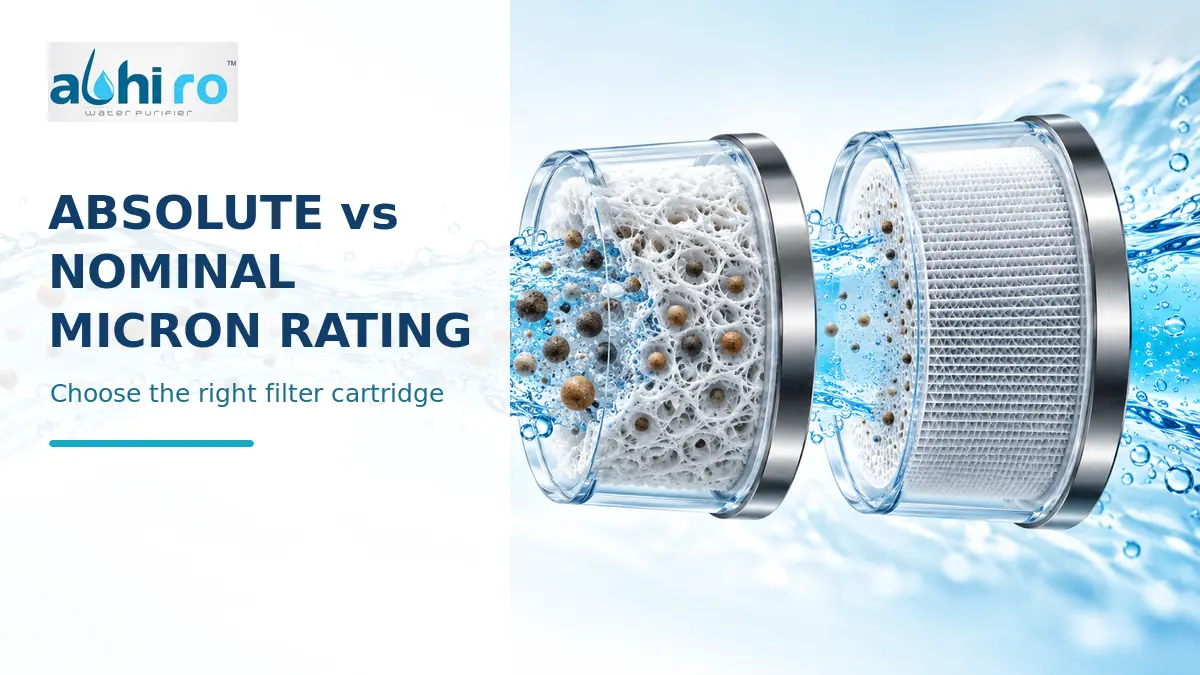
A micron rating tells you the particle size a filter is designed to retain, but the number is incomplete unless you know whether the rating is nominal or absolute and what efficiency test supports it. Choose a cartridge by required removal efficiency, feed-water solids, flow and acceptable pressure drop—not by selecting the smallest micron number available.
What You Will Learn
- What a micron rating actually means
- How nominal and absolute ratings differ
- How to select the correct cartridge
- How pressure drop affects the decision
- Common selection mistakes
- Frequently asked questions
What a Water-Filter Micron Rating Actually Means
A micron rating describes the particle size associated with a filter’s retention performance. One micron is one-thousandth of a millimetre. The rating concerns suspended particles; it does not show that a cartridge can remove dissolved salts, hardness or every microorganism.
Two cartridges marked with the same micron number can perform differently because their media, pore structure, thickness, construction and test methods differ. A spun polypropylene depth cartridge, a pleated surface cartridge and a string-wound cartridge may all carry a “5 micron” label, yet their dirt-holding behaviour and removal efficiency may not be identical.
This is why a buyer should ask for the rating type and supporting performance information, especially when the filter protects an RO membrane, dosing system, pump seal or sensitive process.
Nominal vs Absolute Micron Rating: The Practical Difference
A nominal rating generally means the filter removes a stated proportion of particles at the indicated size under the manufacturer’s test conditions. An absolute rating indicates a more tightly defined retention level, but the word “absolute” is still meaningful only when the supplier identifies the efficiency and test method.
| Point | Nominal rating | Absolute rating |
|---|---|---|
| Meaning | Approximate or supplier-defined retention at the stated size | Defined high retention at the stated size under specified test conditions |
| Best use | General pretreatment and duties where some particle passage is acceptable | Critical protection or processes requiring more predictable retention |
| What to verify | Removal efficiency, test conditions and media construction | Efficiency, test method and whether the claim is single-pass or multi-pass |
| Buying risk | Comparing only the micron number | Assuming every “absolute” product uses the same definition |
There is no safe universal assumption that every nominal cartridge has one fixed percentage efficiency. Definitions vary by supplier. When performance matters, compare data sheets using the same particle size, efficiency and test basis rather than relying on the label alone.
How to Choose the Correct Micron Rating
The correct cartridge is the coarsest rating that reliably protects the downstream process without excessive particle passage. Choosing unnecessarily fine filtration can shorten cartridge life, increase pressure loss and raise operating cost.
- Define what needs protection. An RO membrane, spray nozzle, instrument or final product may require different particle control.
- Assess the feed water. Record turbidity, visible solids, seasonal changes and any upstream media carryover. A single clear-looking sample may not represent the full operating cycle.
- Confirm the required efficiency. Decide whether nominal filtration is sufficient or whether a specified absolute rating is needed.
- Check design flow. Confirm the cartridge length, quantity and housing arrangement can pass normal and peak flow without excessive initial differential pressure.
- Match media to the duty. Consider chemical compatibility, temperature, cleanability, fibre release and whether depth or surface filtration is more suitable.
- Plan staged filtration. Where solids loading is high, a coarse upstream stage followed by a finer polishing stage may be more economical than one very fine cartridge.
ABHIRO’s industrial RO filter-housing range provides the relevant pillar for matching cartridge size, connection and housing configuration. For heavier solids or higher-flow duties, also compare the operating trade-offs in the cartridge vs bag filter housing guide.
Why Pressure Drop Matters as Much as Micron Size
Differential pressure across the housing shows how much resistance the cartridge creates. A finer element or a heavily loaded cartridge usually produces more resistance, which can reduce downstream flow and starve a high-pressure pump if the system is not designed correctly.
- Install readable pressure gauges before and after the housing.
- Record the clean-cartridge pressure drop at a known flow.
- Compare readings at similar flow and temperature.
- Follow the housing and cartridge manufacturer’s replacement limit.
- Investigate unusually rapid loading instead of only replacing cartridges.
Rapid pressure-drop increase may point to high turbidity, inadequate upstream backwashing, biological growth, media carryover or an undersized housing. ABHIRO’s industrial RO pressure-drop troubleshooting guide explains how to isolate restrictions across the wider plant.
Common Micron-Rating Selection Mistakes
The most common mistake is treating a smaller micron number as automatically better. Filtration must balance particle removal, flow, dirt capacity and maintenance.
- Comparing nominal and absolute products as though they are equivalent
- Ignoring the supplier’s efficiency and test method
- Using a fine polishing cartridge for heavy raw-water solids
- Selecting a housing by connection size without checking element area and flow
- Changing cartridges only by calendar instead of pressure-drop trend and water condition
- Assuming a particulate cartridge removes dissolved TDS or hardness
For industrial plants in Coimbatore and elsewhere in India, raw-water quality can change between borewell sources, municipal supply, tanker water and seasons. Review the selection when the source or pretreatment changes rather than repeating the original cartridge choice indefinitely.
Frequently Asked Questions
Is a 1-micron filter always better than a 5-micron filter?
No. A 1-micron element may retain smaller particles, but it can block faster and create more pressure loss. Use the finest rating required by the downstream process, supported by adequate housing area and upstream pretreatment.
Can micron filters reduce TDS?
Ordinary sediment cartridges remove suspended particles, not dissolved salts. TDS reduction normally requires a suitable membrane or other dissolved-solids treatment process.
Should an RO prefilter be nominal or absolute?
It depends on the RO design, feed water and membrane supplier’s requirements. Nominal filtration may be adequate in some systems; critical applications may require a defined absolute performance. Confirm the specification rather than choosing by price alone.
When should a cartridge be replaced?
Replace it when differential pressure reaches the approved limit, outlet quality deteriorates, flow becomes inadequate or inspection shows damage. Always isolate, drain and fully depressurise the housing before opening it.
Get Cartridge and Filter-Housing Selection Support
ABHIRO Water Purifier supplies water-treatment filter housings, cartridges and RO components in Coimbatore. Share your water source, flow, current pressure readings, existing housing size and required particle-removal performance with the ABHIRO team. Contact ABHIRO for application-based selection support, and browse the Water Treatment Knowledge Centre for related maintenance guides.